The Most Expensive Drugs Ever Made: What Biologics Cost, and Who Pays
Humira at $80,000 a year. Skyrizi at $90,000. Stelara at $50,000. The monoclonal antibodies that transformed autoimmune care are among the most expensive products ever sold to consumers — and the carnivore and metabolic-health community has been quietly building a separate story about diet and disease that complicates the standard prescription pathway. What biologics are, what they cost, and the honest middle between the drug and the alternative.
The monoclonal antibody drugs that came out of late-1990s biotechnology — Humira, Enbrel, Remicade, Stelara, Cosentyx, and dozens more — are among the great clinical achievements of modern medicine. They intercept inflammatory signals before they reach immune cells, often stopping autoimmune disease in its tracks. They are also among the most expensive products ever sold to consumers, with US list prices that can exceed $80,000 per year. This essay traces what biologics are, what they cost, the patient stories emerging from the carnivore and metabolic-health communities about stepping off them, and the harder honest question of who pays and why. Not everyone can or should stop these drugs; what follows is reporting on a cost question and a community discussion, not medical advice.
What a biologic actually is
Most biologics are monoclonal antibodies — large engineered proteins, manufactured in living cell cultures, designed to bind one specific molecular target. The major autoimmune class binds inflammatory signalling proteins: TNF-alpha (the target of Humira, Remicade, and Enbrel), or interleukin-17 (Cosentyx, Taltz), or interleukin-23 (Stelara, Skyrizi, Tremfya). The drug intercepts the signal before it reaches the immune cell, often halting the cascade that leads to inflammation, tissue damage, and pain. This is molecularly elegant work. It is also hard work. The antibody molecule cannot be synthesized chemically the way a small-molecule pill can. It must be grown in a CHO (Chinese hamster ovary) cell line, purified over months in sterile conditions, and shipped cold-chain to the patient or clinic. Manufacturing complexity is one reason — though far from the only reason — these drugs cost what they do.

The price tag
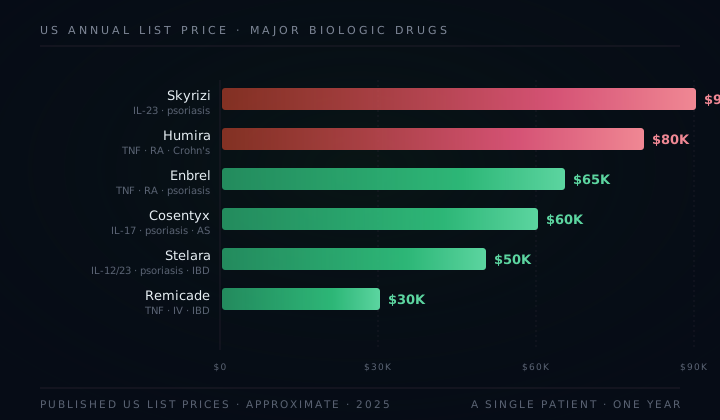
The headline numbers are public and startling. In the United States, Humira (adalimumab) carries a list price around $80,000 per year. Stelara (ustekinumab) is approximately $50,000 per year. Enbrel (etanercept) runs near $65,000 annually. Remicade (infliximab), given by infusion, is around $30,000 per year. Cosentyx (secukinumab) sits near $60,000; Skyrizi (risankizumab) approaches $90,000. These are list prices — the starting point for negotiation. What an insured American patient actually pays out-of-pocket is often reduced to a few hundred dollars per month, thanks to insurer-negotiated rebates and manufacturer copay assistance programs designed to keep patients on the drug. What an uninsured patient pays can approach the full list. What a Canadian or European national health system pays per dose is typically a fraction of the US list, negotiated in bulk with the threat of market exclusion. These are, by any measure, some of the most expensive drugs ever brought to market.
Why they cost what they cost
Three reasons, stated plainly. First, the underlying biology: growing a monoclonal antibody in cell culture, purifying it to pharmaceutical grade, and maintaining cold-chain distribution is genuinely expensive — far more so than pressing out small-molecule pills. Second, the patent system: a successful biologic enjoys years of market exclusivity during which there is no generic-equivalent competitor. Third, the business model: pharmaceutical companies price to what the US insurance system will bear, and that ceiling has been very high. The expiry of patents has been followed slowly by biosimilars (the biologic equivalent of generics), but US uptake has been muted because rebate contracts and formulary design often disincentivise switching stable patients to a cheaper alternative. Siddhartha Mukherjee discusses the manufacturing complexity; Anthony Chaffee discusses the price-discovery mechanisms; the patient community discusses what arrives on their doorstep, and what it costs them to stay well.
What people in the community actually say
The patient stories that recur across the carnivore and metabolic-health transcripts follow a familiar arc. A diagnosis: psoriasis, Crohn's disease, rheumatoid arthritis, ulcerative colitis, ankylosing spondylitis. A referral to a rheumatologist or gastroenterologist. A prescription for a biologic. The injection schedule — weekly, biweekly, monthly. The relief that often follows, sometimes dramatic. The cost — sometimes covered, sometimes shocking, always present in the background. The slow worry about long-term immune suppression. And then, for a meaningful minority, the independent decision to try eliminating dietary triggers: carbohydrate, plant lectins, oxalates, seed oils, dairy, depending on the individual and the community they find. The recurring story is of being able to taper or stop the biologic, often under a physician's supervision, sometimes not. One speaker recounts stopping all biologics after one month on carnivore, watching inflammation markers drop to normal over three months, and finally telling the physician what had happened. Another describes years on Humira and methotrexate, escalating to infusions, before dietary change allowed a full taper. The refrain is consistent: the drug was meant to be lifelong, but it wasn't.
The hosts who are also clinicians
Anthony Chaffee, a carnivore-diet physician, frames biologics as a symptom of upstream failure: many of his patients have presented with autoimmune disease that resolved on a species-appropriate diet, and the biologic that was prescribed as lifelong was tapered and stopped. Shawn Baker, an orthopaedic surgeon turned carnivore advocate, makes a similar point: biologics are doing work that lifestyle could often do upstream, at lower cost and without immune suppression. Mukherjee, the oncologist-author, situates biologics differently — as extraordinary agents that are also a structural feature of a healthcare economy that has become dependent on them, both clinically and financially. His framing is less about the individual patient's choice and more about the system that prices, prescribes, and profits from these drugs. All three acknowledge the clinical power of biologics; all three note the cost, the dependency, and the question of what else might be tried first.
The lifestyle position, stated carefully
The community's claim, in its strongest defensible form, is this: autoimmune conditions are heterogeneous in origin and trajectory. Some patients respond to dietary intervention; many do not. The carnivore and low-carb metabolic communities report enough remissions, or large reductions in symptoms and medication burden, to make the claim worth hearing. The mechanisms most often cited are gut barrier repair (reducing intestinal permeability that may trigger immune reactivity), removal of plant-derived irritants such as lectins and oxalates, reduction in systemic inflammation through elimination of processed seed oils and refined carbohydrate, and weight loss reducing metabolic strain on joints and organs. None of these mechanisms is fully proven in randomised controlled trials at the scale required for consensus acceptance. Some have growing observational and mechanistic support. The position this essay holds is that a serious patient with a serious diagnosis can rationally explore dietary change with their physician — not as a replacement for medical care, but as a complementary track that has produced visible, reproducible results for a subset of community members large enough to warrant attention.
Who actually pays
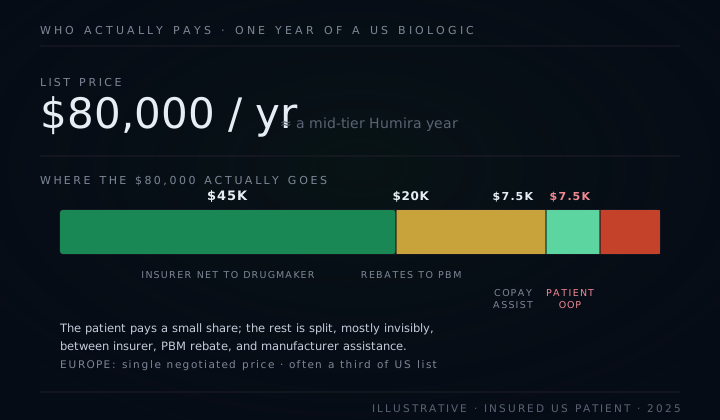
The US list price for a biologic is paid by no single entity. The actual bill is distributed among the patient (deductible and copay), the insurer (negotiated rate, after rebates), the employer or government program (premium subsidy or direct coverage), and often the drug manufacturer itself, through copay assistance cards designed to insulate the patient from cost and keep them on the branded drug regardless of insurance change. The European and Canadian model bypasses most of this fragmentation: a national health system negotiates a single price, often a small fraction of the US list, with the implicit threat that refusal means loss of market access. The cost question for biologics is therefore inseparable from the country in which a patient happens to receive their autoimmune diagnosis. In one jurisdiction, the drug is nearly free at point of care; in another, it can bankrupt an uninsured household.
The biosimilar slow burn
Biosimilars — the equivalent of generic drugs for biologics — have existed for over a decade. Adalimumab biosimilars (generic Humira) launched in the United States in 2023, following patent expiry. Adoption has been slower than the small-molecule generic story most patients have in mind. The reasons are not strictly medical. Insurer formularies still preferentially cover the originator molecule in many cases. Rebate contracts favour the established brand, which can offer larger rebates to pharmacy benefit managers than a new biosimilar entrant can. Physicians are cautious about switching patients who are stable on a working therapy, even when the biosimilar is clinically equivalent. The trend is moving toward broader biosimilar use, but it is moving more slowly than cost-conscious patients and policymakers would prefer.
The honest middle
Biologics are not villains. They are doing for autoimmune disease what almost nothing else can do for many patients: halting progression, restoring function, giving back years of life. The carnivore-community claim — that diet can replace the drug for some patients — is overstated in its strongest forms and dismissed too quickly in its weakest. The truth is somewhere in between. The cost is real. The relief is real. The alternative path is real for some people, documented in enough individual cases to be worth considering, though not universal and not a substitute for clinical judgment. None of this is advice to stop a biologic without medical supervision. It is a call to hold two facts at once: these drugs work, and they cost more than almost any other therapy in the history of medicine, and a meaningful number of patients have found a way off them through dietary change. All of that deserves a careful conversation with a physician who knows the case, the patient, and the evidence.
The biologic on the patient's kitchen counter is one of the most sophisticated molecular interventions ever sold to consumers. It is also one of the most expensive. Both of those facts deserve to be carried at once, and both deserve answers that the current system has not yet provided.