What Viewers Reported: 238 Comments Under a Joe Tippens Fenbendazole Video
The comment section under a YouTube video on Joe Tippens' fenbendazole cancer protocol contains dozens of self-reported patient stories, dosing questions, proposed mechanisms, and skeptical pushback — none of it verified, all of it worth reading with that in mind.
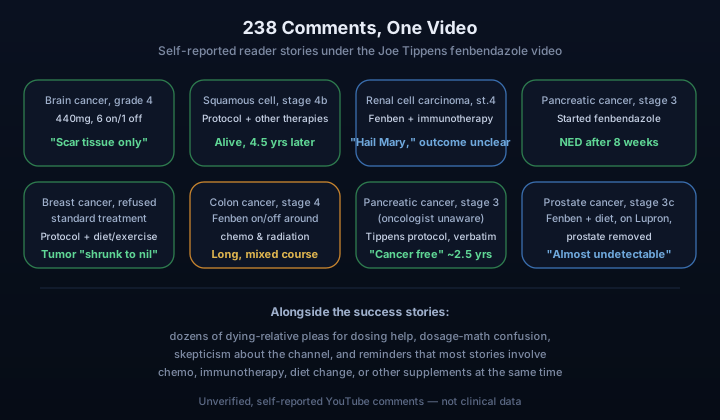
Source note: this article is not drawn from a video transcript. It's drawn from the comment section — all 238 comments — underneath a video titled "My favourite Stage 4 survivors – Joe Tippens: Why I took fenbendazole and why I stopped," posted on the "She Dares Live" channel. That means everything below is unverified, self-reported commentary from anonymous YouTube users, not a clinical dataset, not peer-reviewed, and not fact-checked by anyone. Treat it accordingly — as a snapshot of what people watching this content are saying and asking, not as evidence that fenbendazole works.
Self-Reported Success Stories
The most-liked comments were personal accounts of cancer patients or their family members using fenbendazole, often alongside conventional treatment. A commenter described a grade 4 brain cancer, on 440 mg of fenbendazole for four months, reporting an MRI showing only scar tissue where the tumor had been. Another described stage 4b squamous cell carcinoma, treated with the Tippens protocol "with other therapies," still alive four and a half years after being given roughly two months to live. A third described stage 3 pancreatic cancer reaching "no evidence of disease" eight weeks after starting fenbendazole.
Several commenters described longer, more tangled journeys. One user described a family friend's mother, age 82, who followed the Tippens protocol for stage 3 pancreatic cancer after her oncologist reacted badly to being asked about it; roughly six months later the same oncologist reportedly called her case a "miracle spontaneous remission," apparently still unaware fenbendazole was involved. Another commenter — in one of the longest posts in the thread — described a multi-year saga spanning stage 4 colon cancer, liver metastases, and brain cancer, cycling on and off fenbendazole around separate courses of chemotherapy, radiation, and surgery, crediting fenbendazole for a roughly 50% tumor reduction his oncologist reportedly attributed instead to chemo. A prostate cancer patient reported nearly a year on a fenbendazole-and-diet regimen, alongside androgen deprivation therapy and a prostatectomy, with disease "almost undetectable."
None of these are independently verifiable. They're first-person claims typed into a YouTube comment box, frequently combining fenbendazole with other supplements, dietary changes, or standard oncology treatment — which several commenters themselves pointed out.
The Confounding Variable Everyone Skipped Past
A recurring pushback thread noted that Joe Tippens himself — whose story the video covers — was reportedly on a Keytruda (pembrolizumab) immunotherapy clinical trial at the same time he was taking fenbendazole, and separately used high-THC cannabis oil (later substituting CBD once he stopped following the protocol publicly, according to one commenter who says he followed Tippens' site for years). Commenters raised the obvious question directly: how would anyone know which of the three — the immunotherapy, the cannabinoids, or the fenbendazole — actually did anything? One commenter also noted Tippens lost roughly 105 pounds from loss of appetite during treatment, raising autophagy as another possible confounder.
Proposed Mechanisms, as Described by Commenters
Several commenters, without citing a formal source, described a proposed mechanism: fenbendazole disrupts microtubules the way it does in parasites, which also disrupts mitosis in cancer cells; it may restrict glucose uptake by cancer cells by reducing glucose transporters and hexokinase 2; and it may reactivate the p53 tumor suppressor gene. One commenter also claimed cancer cells don't develop resistance to fenbendazole the way they do to chemotherapy drugs, because they don't pump it back out via P-glycoprotein efflux pumps the way they do other anti-cancer agents. These are claims made in a comment section, not citations to be taken as established fact — the video itself is about a self-treatment story, not a mechanistic review.
One frequent commenter posted repeated links to peer-reviewed literature on related compounds — a mouse-model paper on mebendazole reducing pancreatic tumor growth and liver metastasis, a paper on albendazole slowing pancreatic cancer cell growth in vitro and in vivo, and separate papers on IP6/inositol, selenium, and insulin resistance in cancer. Those citations point to real published research on related anthelmintic drugs — but they are being used here to support a self-medication story, not being weighed by the actual authors of those papers.
Safety Notes Raised in the Comments
A few comments flagged specific safety concerns worth taking seriously regardless of where you land on the broader question. One pointed to a study showing fenbendazole significantly worsened acetaminophen-induced liver toxicity in mice — a relevant interaction warning for anyone combining the two. Another warned that counterfeit veterinary fenbendazole products have been sold through major retailers. A commenter also suggested stopping fenbendazole immediately before cytotoxic chemotherapy, reasoning (without citing a source) that fenbendazole arrests cells at a point in the cycle that could make them less vulnerable to chemo drugs timed to hit dividing cells.
The Questions Nobody in the Comments Could Really Answer
The largest single category of comments, by far, was people asking for help: a son with a bedridden father with pancreatic cancer, a wife with HER2-positive breast cancer metastasized to the liver, a mother with stage 4 lung cancer found three weeks earlier, a 23-year-old with relapsed Hodgkin's lymphoma — all asking, in a YouTube comment section, what dose to use, where to source human-appropriate fenbendazole, and whether it would work for their specific diagnosis. Others got tangled in the dosing math itself: veterinary fenbendazole products like Panacur and Safeguard are often only around 20% fenbendazole by weight, and several commenters were visibly confused about how to convert a gram of product into a milligram dose of the actual drug. None of these questions were answered by a medical professional in the thread — they were answered, if at all, by other commenters guessing alongside them.
Skepticism, Also Present
Not every comment was supportive. A few accused the channel of being a "shill" for pharmaceutical interests based on its production quality, others pointed out mispronunciations of the drug's name as a credibility issue, and at least one commenter directly challenged the video's framing of a case where cancer had spread, asking whether fenbendazole itself might have been the reason rather than a side factor. This is worth noting precisely because it did not come from a dissenting outside source — it came from within the same comment section as the success stories.
What This Actually Is
This is a compilation of what real people said in a public YouTube comment section — not a study, not a case series with medical documentation, and not something that has been checked for accuracy. Nearly every reported "success" involved fenbendazole used alongside chemotherapy, immunotherapy, radiation, surgery, dietary changes, or a stack of other supplements, which several commenters flagged themselves as a reason to be cautious about crediting fenbendazole specifically. The volume and consistency of these reports may be part of why the topic keeps generating clinical interest elsewhere — but the comments themselves are anecdote, not evidence.
Source: the public comment section (238 comments) of "My favourite Stage 4 survivors – Joe Tippens: Why I took fenbendazole and why I stopped," She Dares Live channel, https://youtu.be/Qm06dgF3nNQ. Not a clinical source. Not medical advice.