Olive Oil, Reconsidered: A Plant Fat in the Carnivore Frame
Universally praised by mainstream nutrition. Unusually scrutinised by the carnivore community. What the carn voices actually say about olive oil, the technical claims behind their scepticism (oxidation, adulteration, the species-appropriate question), what the strongest counter-arguments are, and the honest middle a careful reader can settle into.
Olive oil occupies an unusual position in the nutritional landscape. To the mainstream, it is nearly above reproach: the cornerstone of the Mediterranean diet, rich in heart-healthy monounsaturated fats, blessed with anti-inflammatory polyphenols, the subject of landmark clinical trials. National dietary guidelines endorse it. Cardiologists recommend it. Yet within the carnivore and metabolic-health community—a loose network of physicians, researchers, and practitioners skeptical of plant-heavy diets—olive oil draws scrutiny that would surprise most consumers. The objection is rarely that olive oil is poison. The claim, rather, is that its case has been overstated, that the product most people actually consume bears little resemblance to what the studies tested, and that in a diet built on animal fats, olive oil is simply unnecessary. What follows is an attempt to trace what the community actually says, the technical substance behind their skepticism, the strongest evidence on the other side, and where a careful reader might reasonably land.
The mainstream position, briefly
Olive oil is the central fat of the Mediterranean diet, which holds the strongest epidemiological support of any dietary pattern for cardiovascular health and all-cause mortality. The PREDIMED trial—a randomized controlled study of over 7,000 participants at high cardiovascular risk—compared a Mediterranean diet supplemented with extra-virgin olive oil against a low-fat control diet and found reduced rates of heart attack, stroke, and cardiovascular death in the olive oil group. The active compound is mostly oleic acid, a monounsaturated fatty acid that is far more stable than the polyunsaturated fats in seed oils like soybean or corn oil. Olive oil also contains polyphenols, including oleocanthal, which has demonstrated anti-inflammatory properties in laboratory settings. This is the position held by most clinical guidelines, by the American Heart Association, and by the majority of practicing cardiologists. The carnivore-community critique that follows is responding to this consensus, not ignoring it.
What the community actually says
The carnivore and metabolic-health community draws a sharp line between industrial seed oils—soybean, canola, corn, sunflower, safflower, cottonseed—which they consider categorically harmful, and olive oil, which occupies a separate, less-condemned tier. The position on olive oil itself is mixed. Physicians like Anthony Chaffee and Shawn Baker describe it as tolerable in moderation, particularly for people transitioning from standard or plant-heavy diets. Strict carnivores, by contrast, eliminate it entirely. The argument is not typically that olive oil is uniquely toxic; the argument is that its benefits have been overstated, that it is not necessary when high-quality animal fats are available, and—crucially—that the version most people purchase and use is not the version the science describes. One community member put it plainly: if you're already eating beef tallow or butter, why complicate things? The deeper claim is philosophical: olive oil is being sold as a universal solution to a problem that may not require plant fats at all.
The oxidation question
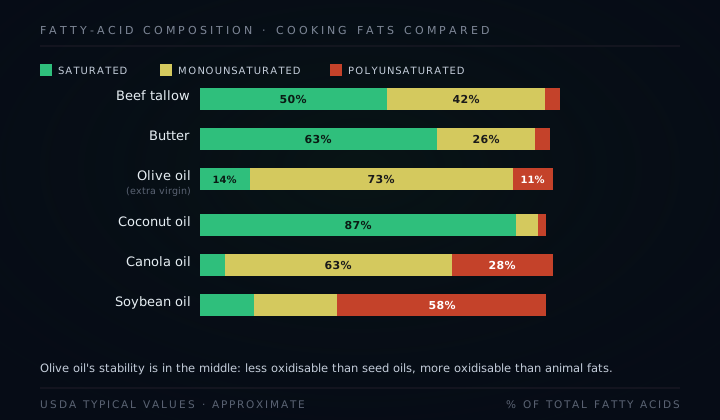
Fatty acids with carbon-carbon double bonds are chemically vulnerable. Heat, light, and oxygen cause them to oxidize, producing compounds—aldehydes, lipid peroxides—that are biologically reactive and, in sufficient quantity, inflammatory. Olive oil is predominantly monounsaturated: each molecule of oleic acid contains one double bond. This makes it more stable than polyunsaturated seed oils (which have multiple double bonds) but less stable than the fully saturated fats in beef tallow or butter, which have none. Refined olive oil tolerates heat better—its smoke point is around 400°F—but the refining process strips away most polyphenols. Extra-virgin olive oil retains those polyphenols, which offer some oxidative protection, but its smoke point is lower, typically between 325°F and 375°F depending on quality and freshness. The community's technical claim is straightforward: cooking olive oil at high heat produces oxidized lipids; storing it under bright grocery-store lighting accelerates the same process; the bottle on your counter, six months after pressing, is rarely the fresh, cold-pressed Mediterranean ideal the studies describe. This is chemically accurate. The magnitude of harm—the dose at which oxidized olive oil becomes a clinical problem—is the contested part.
The adulteration problem
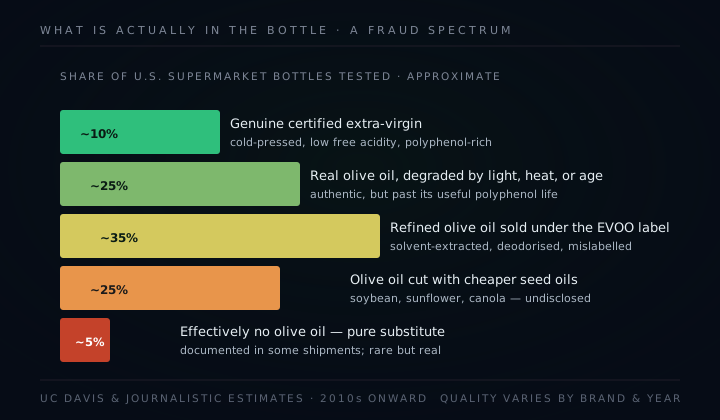
Olive oil fraud is one of the best-documented food-fraud stories of the last two decades. Laboratory testing by UC Davis and investigative journalism—most notably Tom Mueller's book and a widely cited New Yorker piece—revealed that a meaningful share of bottles labeled "extra virgin" in American supermarkets fail to meet that designation. Some are cut with cheaper refined olive oil; others are adulterated with seed oils entirely; some contain no olive oil at all. The Italian mafia has historically been involved in large-scale olive oil counterfeiting. The problem is not fringe: it is widespread, profitable, and difficult to detect without chemical analysis. The carnivore community cites this frequently, and while they sometimes overstate the prevalence, the underlying claim is true. The bottle you buy may not contain what the label says. This is a genuine consumer-protection issue that exists independently of the nutritional argument, and it complicates any claim that "olive oil" as purchased is delivering the studied benefits of genuine extra-virgin oil.
The "species-appropriate" frame
The deeper philosophical claim some voices make is evolutionary. Olives are bitter and essentially inedible raw; the technology to cold-press table-quality olive oil developed over the last few thousand years in a narrow band around the Mediterranean. For the vast majority of human history, our ancestors did not eat olive oil. One speaker framed it this way: it takes 45 olives to make a single tablespoon of olive oil—would you sit down and eat 45 olives? The argument is that a food requiring significant technology, specific to one geographic population, should not be positioned as a universal nutritional necessity. The counter-argument is equally straightforward: very little of what modern humans eat is evolutionarily ancient, and "ancestral" is not synonymous with "optimal." Cooking itself is a technology. Fire is a technology. The species-appropriate frame is interesting as a heuristic but is not, on its own, dispositive.
What the studies actually show
PREDIMED remains the cornerstone of the case for olive oil. It randomized over 7,000 people at high cardiovascular risk to one of three diets: Mediterranean diet supplemented with extra-virgin olive oil, Mediterranean diet supplemented with nuts, or a low-fat control diet. The olive oil group showed reduced cardiovascular events. The trial was re-analyzed after methodological concerns about randomization in some centers, but the headline finding largely survived. What PREDIMED does not show is that olive oil is superior to animal fats, because animal-fat-rich diets were not tested. The comparator was a low-fat, relatively high-carbohydrate control. The carnivore community's point is fair: PREDIMED is not the comparison most of them are making. If the question is whether olive oil is better than butter or tallow in the context of a low-carbohydrate, meat-based diet, PREDIMED offers no answer. The trial shows that in a Mediterranean dietary context, replacing refined carbohydrates and seed oils with olive oil improves outcomes. It does not show that olive oil is necessary if those harmful inputs are already absent.
What the physicians actually recommend
The clinical voices in the carnivore community frame olive oil with varying degrees of tolerance. Anthony Chaffee describes it as acceptable in small amounts for people not following strict carnivore, but unnecessary if animal fats are available. Shawn Baker's framing is broader: the cooking-fat debate, he suggests, is less interesting than the question of why so much added fat is needed in the first place—if the meat is fatty enough, the issue rarely arises. Others note that olive oil in the context of a whole-food Mediterranean pattern is likely doing much of its work by displacing ultra-processed foods, not by any unique property of the oil itself.
"I would replace it for butter if it was me," one practitioner said, while advising a gradual transition for those concerned about oxalate dumping from eliminating vegetables.The consensus, where one exists, is this: olive oil is not harmful in the way seed oils are harmful, but it is also not necessary, and the version people actually use is often compromised.
The honest middle
Olive oil is not a poison. The carnivore community's strongest rhetoric—that it is unnecessary, overrated, often fraudulent—contains truth but overstates the case for complete elimination. Olive oil is also not a uniquely health-giving elixir. The mainstream position's strongest claims—that it is anti-inflammatory, cardioprotective, essential—rest on evidence that is real but contextual. A bottle of genuinely extra-virgin, recently pressed, properly stored olive oil, used sparingly and not heated past its smoke point, is plausibly fine for most people. It may even be beneficial in the context of a diet that includes vegetables, legumes, and whole grains, where it is displacing worse fats and worse carbohydrates. A cheap supermarket bottle, partially refined or adulterated, stored under fluorescent light for months, heated repeatedly in a skillet to 400°F, is a different product. That product deserves the skepticism the carnivore community applies. The species-appropriate argument is a useful lens but not a verdict; humans have eaten non-ancestral foods for millennia, sometimes to great benefit.
The bottle on your kitchen counter is a more complicated object than its packaging suggests. The carnivore and metabolic-health community noticed this earlier and more clearly than the mainstream nutrition press, even if their conclusions sometimes outrun the evidence. A careful reader can take from this both a healthier skepticism of the marketing and a healthier skepticism of the contrarian counter-narrative. The truth, as usual, sits somewhere in the middle, waiting to be approached with honesty.