From Single Cell to Edited Genome: Ramakrishnan on Fertilization and the Future of Heritable DNA
How a sperm and an egg fuse into one cell that carries a full human being inside it, and what the new genome-editing tools could do to that single cell. The Nobel laureate and former Royal Society president on what we now know how to do, and the governance vacuum he keeps pointing to.
Venki Ramakrishnan is a Nobel laureate in chemistry, a structural biologist who spent decades decoding the ribosome—the molecular machine that translates genetic information into proteins in every living cell. More recently, as former president of the Royal Society and author of Why We Die, he has turned his attention to two vast questions: why we age, and how new technologies might allow us to intervene in the biological instructions we inherit. This essay explores both: how a sperm and an egg combine to form a single cell that resets the aging clock to zero, and how gene-editing tools like CRISPR could, in principle, rewrite what is encoded in that cell—with consequences that would ripple through every cell in the body and into every generation that follows.
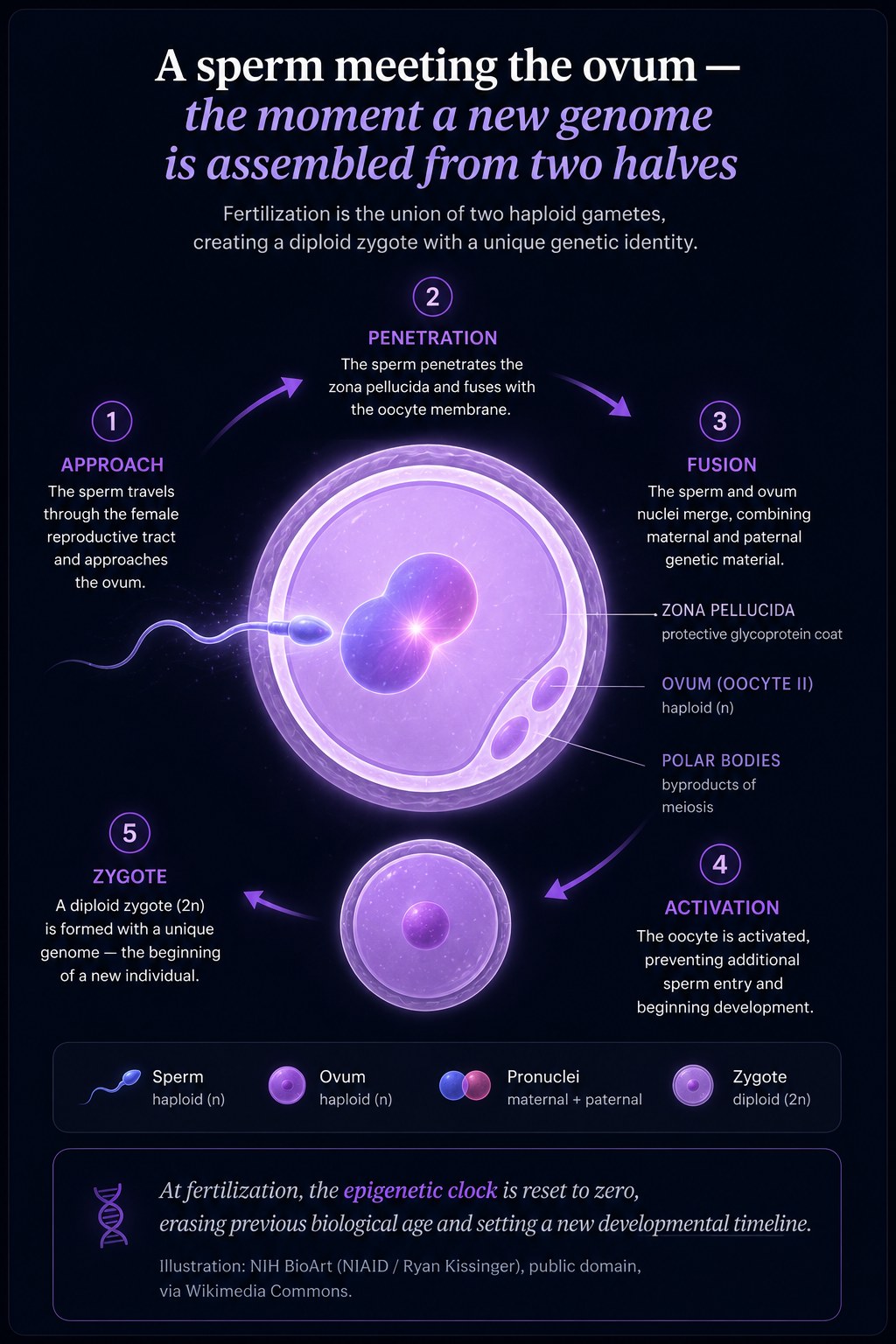
The single cell that contains everything
Fertilization is, at its simplest, the fusion of two half-genomes into one. A sperm carries twenty-three chromosomes; an egg carries twenty-three more. When the two meet, their genetic material combines to form a zygote: a single cell with the full complement of forty-six chromosomes, the complete instruction set for building a human being. That zygote is unlike any other cell in the body. It is totipotent—capable of giving rise not only to every tissue and organ, but also to the placenta. It is, as Ramakrishnan puts it, "the ultimate stem cell." Over the hours and days that follow, that single cell divides, and its descendants begin to specialize: some become pluripotent stem cells that can form any tissue in the body; others differentiate further into blood, muscle, bone, nerve. But at the moment of conception, the zygote is everything, and everything to come.
The clock resets
Here is the paradox Ramakrishnan returns to again and again: the cells that form the zygote—sperm and egg—come from parents who may be twenty, forty, or older. Yet the child conceived is not born old. Ramakrishnan frames it plainly: "A child born to a 40-year-old woman is not 20 years older than a child born to a 20-year-old woman." Both children begin at effectively age zero. How? The answer lies not in the DNA itself, but in the chemical marks laid on top of it—the methylation patterns and histone modifications that accumulate over a lifetime and regulate which genes are expressed. These marks are the hallmarks of epigenetic age. At fertilization, they are erased. The germline, Ramakrishnan notes, is in this sense immortal: it resets the aging clock with every generation. The implication is profound. Aging is not a fixed property of our cellular material; it is something the body actively maintains, and the germline demonstrates that it can be undone.
Editing the bases versus editing on top of them
Ramakrishnan is careful to distinguish two kinds of intervention, because they operate at different levels and carry different stakes. "Gene editing," he explains, means changing the letters of DNA themselves—the A, T, C, and G that spell out the genetic code. "Epigenetics" refers to chemical groups, often methyl tags, added on top of the DNA sequence without altering the underlying letters. CRISPR is gene editing: it changes the code. Most of the aging interventions discussed today—from caloric restriction mimetics to drugs that target senescent cells—work through epigenetic or regulatory pathways. The two are different operations. One rewrites the text; the other changes how the text is read. The distinction matters, because rewriting the text in a zygote is permanent.
What CRISPR actually is
CRISPR-Cas9, discovered by Jennifer Doudna and Emmanuelle Charpentier, is a molecular tool adapted from a bacterial immune system. It uses a guide RNA to locate a specific sequence in the genome, and the Cas9 protein acts as molecular scissors, cutting the DNA at that site. The cell's repair machinery then patches the break, and in doing so can introduce a desired change—correcting a mutation, deleting a gene, or inserting a new sequence. As Ramakrishnan notes, Doudna and Charpentier's work opened the door to precise genome editing in ways that were previously unimaginable. Since then, refinements like base editing and prime editing have improved accuracy and reduced off-target effects. The technology is advancing rapidly, and the rate of progress shows no sign of slowing.
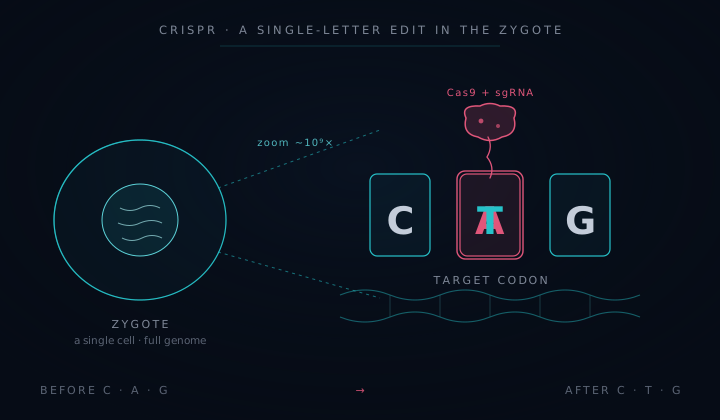
Editing the embryo, editing the line
There is a fundamental distinction in gene therapy between somatic editing and germline editing. A somatic edit—say, to the cells of a patient's liver or blood—affects only that individual. The change dies with them. A germline edit, by contrast, is heritable: it is passed to every descendant cell, including eggs or sperm, and thus to the next generation. Editing a zygote is, by definition, germline editing. You cannot confine a change to one tissue when the edit is made in a single-celled embryo that will become every tissue. The implications are unavoidable: the edit will be present in every cell of the resulting person, it will be inherited by their children, and it applies to someone who has not—and cannot—consent. That is the bright line that most regulatory bodies have agreed not to cross.
How this differs from IVF as it already exists
In vitro fertilisation has been a routine clinical procedure for nearly five decades. A sperm meets an egg in a dish — the same fusion that happens inside the body, just made accessible to a clinician. What the clinic does next is the relevant distinction. The embryo can be transferred to the uterus as it is; this is standard IVF. Or, where there is a known family risk for a serious heritable disease, several embryos can be created and each tested for the disease-causing variant before transfer. Only an unaffected one is transferred. The embryos that carry the variant are discarded, frozen, or donated to research; their DNA is not altered.
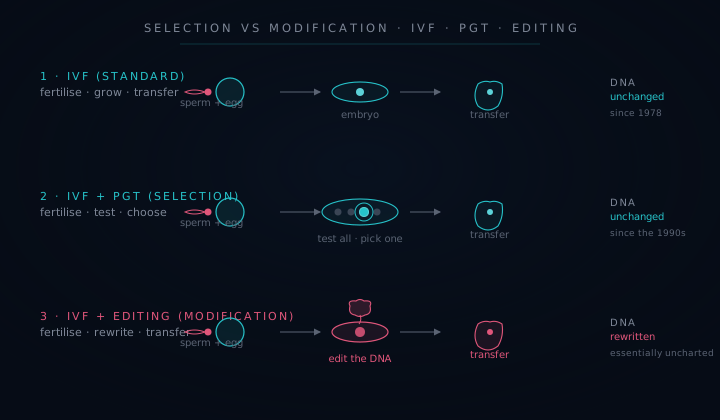
This procedure — preimplantation genetic testing, or PGT — has been in clinical use since the early 1990s. It is selection, not modification. The genetic material in every embryo that gets transferred is exactly what the parents contributed. The technology filters which of the existing combinations is allowed to proceed.
Editing the genome of a zygote is a categorically different intervention. It does not choose between the genomes the parents produced. It writes something into the genome that neither parent contributed — a new letter at a specific position, a sequence that did not exist in either lineage. The resulting person carries an edit engineered into them. Their children, and their children's children, will carry it too. PGT can prevent an inherited disease from being expressed in this generation; editing rewrites what the lineage carries forward.
That difference — selection versus authorship — is why the genome-editing debate Ramakrishnan helps lead sits on a different moral footing from the IVF practice it would extend. The infrastructure is largely the same: same lab, same fertilisation dish, same embryologists. What changes is whether the cell that gets transferred is one of nature's possibilities or one of ours.
Ramakrishnan at the Royal Society
As president of the Royal Society from 2015 to 2020, Ramakrishnan co-organized international summits on genome editing, convening scientists, ethicists, and policymakers to map the landscape of what was becoming possible. The consensus that emerged was cautious: somatic gene therapies are being evaluated and approved case by case, as drugs are; germline editing in humans remains off-limits. That consensus hardened in the wake of the He Jiankui affair in 2018, when a Chinese scientist announced he had edited the genomes of twin girls to confer resistance to HIV. The international response was swift and condemnatory. Ramakrishnan's position, shaped by those summits, reflects the field's: we do not yet know enough about unintended consequences—mosaicism, off-target effects, long-term health impacts—to responsibly edit the human germline.
The governance gap he keeps pointing to
Ramakrishnan returns repeatedly to a broader concern: we are facing what he calls a "tsunami of converging technologies"—gene editing, artificial intelligence, brain-machine interfaces, quantum computing, advanced robotics—all arriving at once, and with no global authority capable of providing coordinated oversight. In the 1930s and 1940s, figures like Einstein and Oppenheimer could write to a head of state and inform him of a technology of which he had been unaware. Today, everyone knows CRISPR exists; the challenge is that different nations will regulate it differently, at different speeds, with different ethical red lines. The world is no longer in a position where a single letter can shape the trajectory of a technology. Ramakrishnan's measured insistence is that we need new mechanisms of governance, and we need them soon.
What that means for the zygote
The single cell formed at fertilization is the only point in a human life where an edit is automatically inherited everywhere downstream. Every tissue, every organ, every cell in the body—and every egg or sperm that person will produce—will carry the change. That makes the zygote the most consequential cell to touch, and the most consequential one to leave alone until we understand more. Ramakrishnan's position is not one of absolute prohibition, but of profound caution. The technology exists. The knowledge of how to use it is spreading. The question is not whether we can edit the genome of an embryo, but whether we should, and under what circumstances, and with whose authority.
The biology of how we begin—sperm meeting egg, two genomes fusing, the epigenetic slate wiped clean—is the same as it has always been. The technology to write into that beginning is new. The asymmetry between those two facts is the work of this generation, and Ramakrishnan has spent the last decade insisting that we reckon with it carefully.