Is the Brain and the Mind the Same Thing?
Neuroscientist David Eagleman explores one of science's deepest questions: the brain is a measurable physical organ, but the mind — the redness of red, the inner voice, the feeling of being you — remains stubbornly hard to explain in purely physical terms.
Every morning when you wake up, something remarkable happens. One moment you're a sack of unconscious tissue. The next, you are you — aware of your name, your history, the smell of coffee, the feel of sheets. What switched on? And what, exactly, is doing the experiencing?
This is the question neuroscientist David Eagleman has spent his career circling. His answer isn't a simple yes or no — it's a window into one of the deepest unsolved problems in science.
The Brain Is Undeniable
Start with what we know. You have roughly 86 billion neurons in your skull, each firing electrical spikes tens to hundreds of times per second, linked by perhaps 100 trillion synaptic connections. This three-pound organ — "our three-pound universe," as Eagleman calls it — controls everything you do, feel, and think.
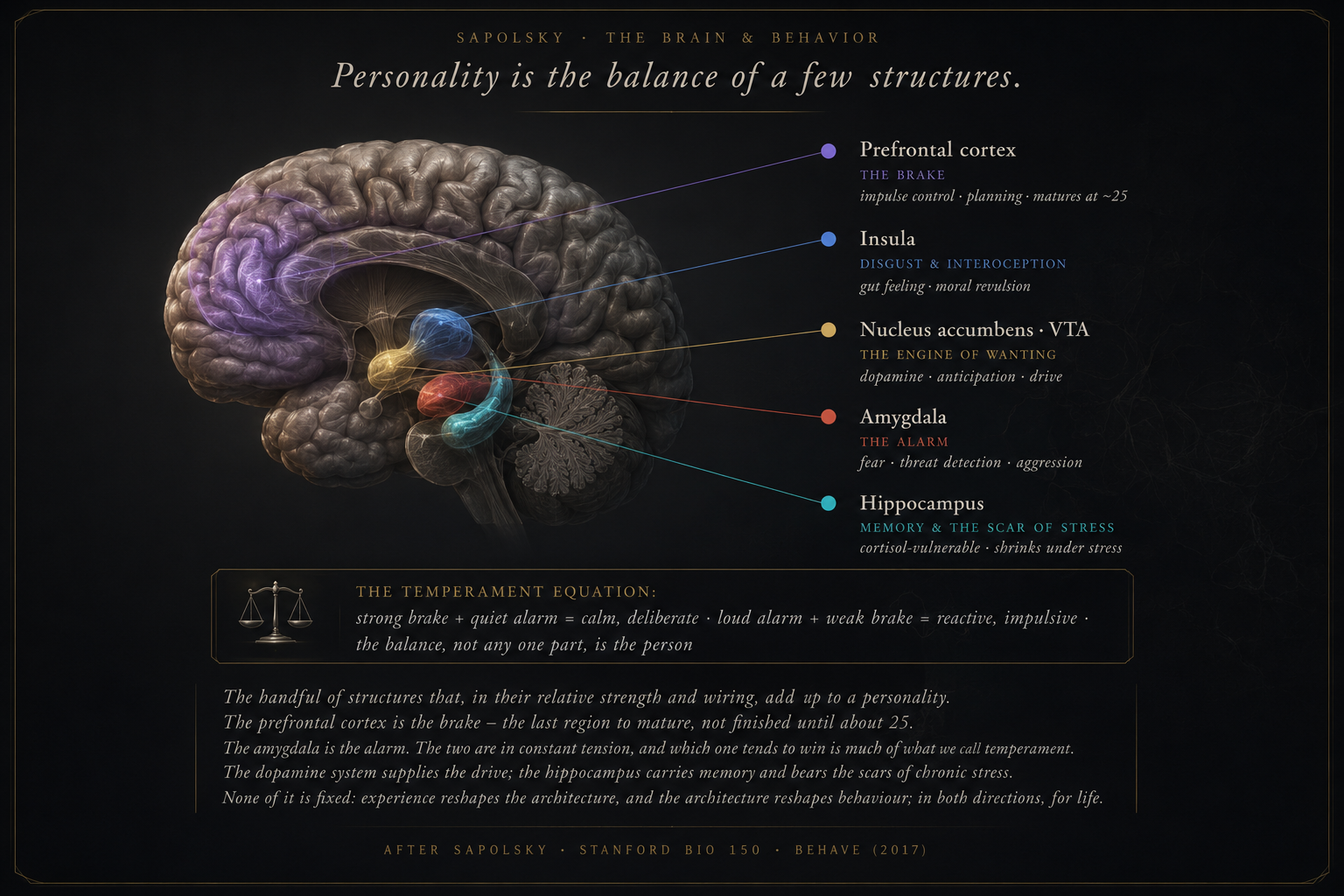
Damage a region of the brain and you lose a piece of yourself. Stroke a motor area and an arm stops moving. Remove the hippocampus and new memories stop forming. Flood the prefrontal cortex with alcohol and your judgment dissolves. Personality, desire, moral reasoning, love — every aspect of your inner life has a neural address. The case that the brain produces the mind looks overwhelming.
Most neuroscientists today subscribe to what Eagleman calls materialism and reductionism: "We should be understandable as a collection of cells and blood vessels and hormones and proteins and fluids all following the basic laws of chemistry and physics." Each day, neuroscientists go into the lab and work under this assumption. And it works — up to a point.
The Thing That Flickers to Life
Here is where the story gets harder. Eagleman defines consciousness simply and precisely: "Consciousness is the thing that flickers to life when you wake up in the morning." You have the same brain the moment before you wake and the moment after. A tiny change in the pattern of neural activity — and suddenly there is someone home. A sack of potatoes becomes a person with a past, a name, and an inner world.
Why? That's the problem. 100 billion neurons having little electrical spikes is not, on its face, obviously different from 19 billion transistors inside an iPhone. Yet we don't believe the iPhone experiences anything when it displays a funny video. As Eagleman puts it: "When your phone gets an email from your boss, does it feel stressed?" Almost certainly not. But your brain, doing something not entirely unlike that computation, does. What is the difference?
This is what philosopher David Chalmers called the "hard problem" of consciousness — and Eagleman takes it seriously. The easy problems are explaining how the brain processes sensory information, controls behavior, reports internal states. The hard problem is explaining why any of that processing is accompanied by experience.
Qualia: The Redness of Red
Consider color. When you look at a red apple, photons hit your retina, signals travel to your visual cortex, and a particular pattern of cells activates. That part is measurable. A neuroscientist can point to exactly which neurons fired.
But why does that pattern feel red to you? There's nothing inherently red about a particular wavelength of light. The redness is something the brain constructs — and it could, in principle, have been experienced as blue or green, or as a sound, or as nothing at all. The inner experience — what philosophers call a quale — is irreducible. It can't be fully described in terms of anything else. If you've never tasted an avocado, no amount of description will give you the experience. The experience is private, subjective, and untransmittable.
As Eagleman's colleague Anil Seth puts it: "For a conscious organism there is something it is like to be that organism." That simple phrase, from philosopher Thomas Nagel, is doing a lot of work. It draws a line between systems that process information (thermostats, phones, possibly very simple animals) and systems that experience something as they do it.
Why Reductionism Hits a Wall
Eagleman uses the Human Genome Project as an analogy for the limits of breaking things down. When scientists sequenced the entire human genome, it was a landmark achievement — and in some ways a surprise. We found that humans share essentially the same genetic recipe as squirrels and tuna fish. The genome tells you the nuts and bolts, not the product. A squirrel and a human are built from similar screws, but they are radically different things. The instruction set doesn't explain the experience of being either one.
The same logic applies to neurons. Even if you mapped every connection in every human brain — a project of staggering complexity — you'd have a wiring diagram. You wouldn't automatically have an explanation of why that wiring diagram is accompanied by the sensation of tasting chocolate, or the ache of loneliness, or the particular quality of hearing your name called in a crowd.
"The brain with its private subjective experience is unlike any of the problems that we've tackled so far," Eagleman writes. "And anybody who tells you that we have the problem cornered with a reductionist approach doesn't actually understand the complexity of the problem."
Eagleman's Honest Position
So is the brain the mind? Eagleman's answer is careful. He doesn't invoke a soul or a non-physical substance. There is no evidence for a ghost in the machine — brain damage, drugs, and sleep all prove the mind is tethered to the physical brain in the most direct way possible. But he is equally honest that our current scientific framework may be insufficient to explain the leap from neurons firing to the feeling of being you.
"Every single generation before us has worked under the assumption that they possessed all the major tools for understanding the universe," he writes, "and they were all wrong without exception." We understood rainbows only after optics. Lightning only after electricity. It's possible — likely, even — that consciousness will require concepts we don't yet have.
What excites Eagleman is not the gap but the territory it reveals. Even in a purely material universe, the fact that arranged molecules can feel awe, compose music, fall in love, and contemplate their own existence is — in his words — "mind-blowingly amazing. Better than anything ever proposed in anyone's holy text."
The Working Answer
Brain and mind are not two separate substances — there is no free-floating mind drifting around without a brain. But they are also not simply identical in the way a wave and the ocean are identical. The mind is what it feels like to be the brain running. It is the first-person perspective generated by a third-person physical process, and bridging those two descriptions remains, for now, the central unsolved problem of neuroscience.
Eagleman's science doesn't erase the mystery — it illuminates how deep it goes. Every time you wake up and experience the world as you, something is happening that the smartest people alive still cannot fully account for. That's not cause for mysticism. It's cause for curiosity.
Based on David Eagleman's Inner Cosmos podcast, including episodes on consciousness, qualia, materialism, and the hard problem of subjective experience.