Epilepsy: GABA/Glutamate Imbalance and the Ketogenic Diet as Standard of Care
Epilepsy was the first neurological condition shown to respond to ketogenic therapy — a century of evidence. Five cases illustrating how ketones raise GABA, reduce glutamate, and restore the seizure threshold.
TL;DR
GABA/glutamate imbalance, neural hyperexcitability, mitochondrial energy. Ketones → GABA↑ in astrocytes. 100yr evidence base. Five cases: drug-resistant focal, childhood absence, GLUT1 deficiency, Lennox-Gastaut, adult drug-resistant.
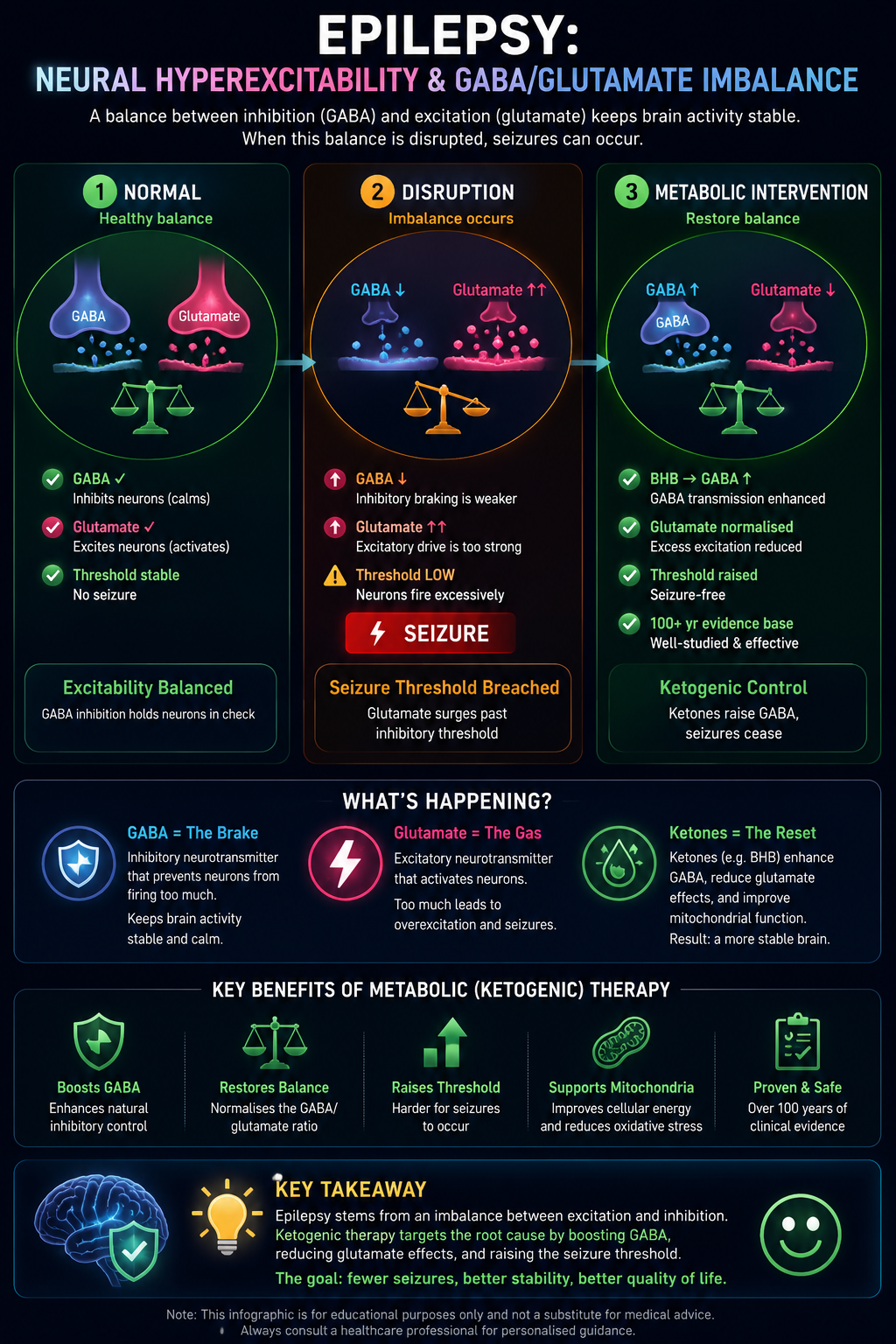
The physiology
Epilepsy is the condition in which the ketogenic diet's neurological mechanism was first scientifically documented — a century of evidence before metabolic psychiatry existed as a field. Seizures occur when neural excitability exceeds the inhibitory capacity of GABA-mediated circuits: glutamate, the primary excitatory neurotransmitter, fires in synchronised bursts that propagate through brain networks. The ketogenic diet raises brain GABA levels through direct metabolic conversion of BHB in astrocytes, reduces glutamate availability, and stabilises the mitochondrial energy supply that ion channel function depends upon.
For the approximately 30% of epilepsy patients who do not achieve seizure control with antiepileptic drugs, ketogenic therapy produces seizure reduction in roughly 50% of cases and complete seizure freedom in approximately 10–15%. It remains the standard of care for specific epilepsy syndromes including GLUT1 deficiency — a condition where the brain cannot import glucose at all and is entirely dependent on ketones for fuel.
Five stories
Lucas — Drug-resistant focal epilepsy
Lucas, 19, had focal onset impaired-awareness seizures since age 14 that had not responded to three antiepileptic medications. His neurologist referred him to a ketogenic diet clinic. Implementation under a dietitian's guidance was strict — classical 4:1 fat to protein-plus-carbohydrate ratio. Within three months his seizure frequency had fallen from approximately twenty per month to two. At six months he had his first fully seizure-free month in five years. He remains on a modified Atkins protocol — more flexible, same principle — four years later.
Beatriz — Childhood absence epilepsy
Beatriz, 8, had hundreds of absence seizures per day — brief lapses in awareness that fragmented her learning and social development. Valproate produced partial control but caused liver enzyme elevation that concerned her parents. Her paediatric neurologist introduced the ketogenic diet. Within six weeks the absence events reduced by 85%. Her parents describe it as getting their daughter back — the child who could hold a conversation without disappearing mid-sentence.
Nathan — GLUT1 deficiency syndrome
Nathan, 12, was diagnosed with GLUT1 deficiency — his brain cannot import glucose across the blood-brain barrier. Without a ketogenic diet he would be entirely without brain fuel. His parents implemented the diet from infancy. On strict ketogenic nutrition his development has been near-normal; his neurological deficits mild. His case illustrates with unusual clarity the fundamental principle: when glucose metabolism fails, ketones rescue brain function.
Finn — Lennox-Gastaut syndrome
Finn, 6, had Lennox-Gastaut syndrome — one of the most severe childhood epilepsy syndromes. Drop attacks caused him to wear a helmet continuously. Three antiepileptic medications had produced minimal benefit. Ketogenic therapy reduced his drop attacks by 60% within four months. His parents describe the improvement as transformative — not a cure, but a meaningful reduction in the seizures most likely to injure him.
Rosa — Adult drug-resistant epilepsy
Rosa, 33, had focal epilepsy originating in the right temporal lobe that had not responded to surgical evaluation. She was offered the ketogenic diet as a last non-surgical option. Compliance was difficult as an adult with a full professional life, but she maintained a modified Atkins protocol. Seizure frequency fell by 70% over nine months. She achieved a driving licence — something she had been denied for a decade — eighteen months into the protocol.