Rheumatoid Arthritis: How Joints Become the Battleground
Rheumatoid arthritis is driven by immune cells that invade the synovial lining of joints, forming an aggressive pannus tissue that erodes cartilage and bone. Unlike osteoarthritis, the damage begins in the immune system, not in the joint itself.
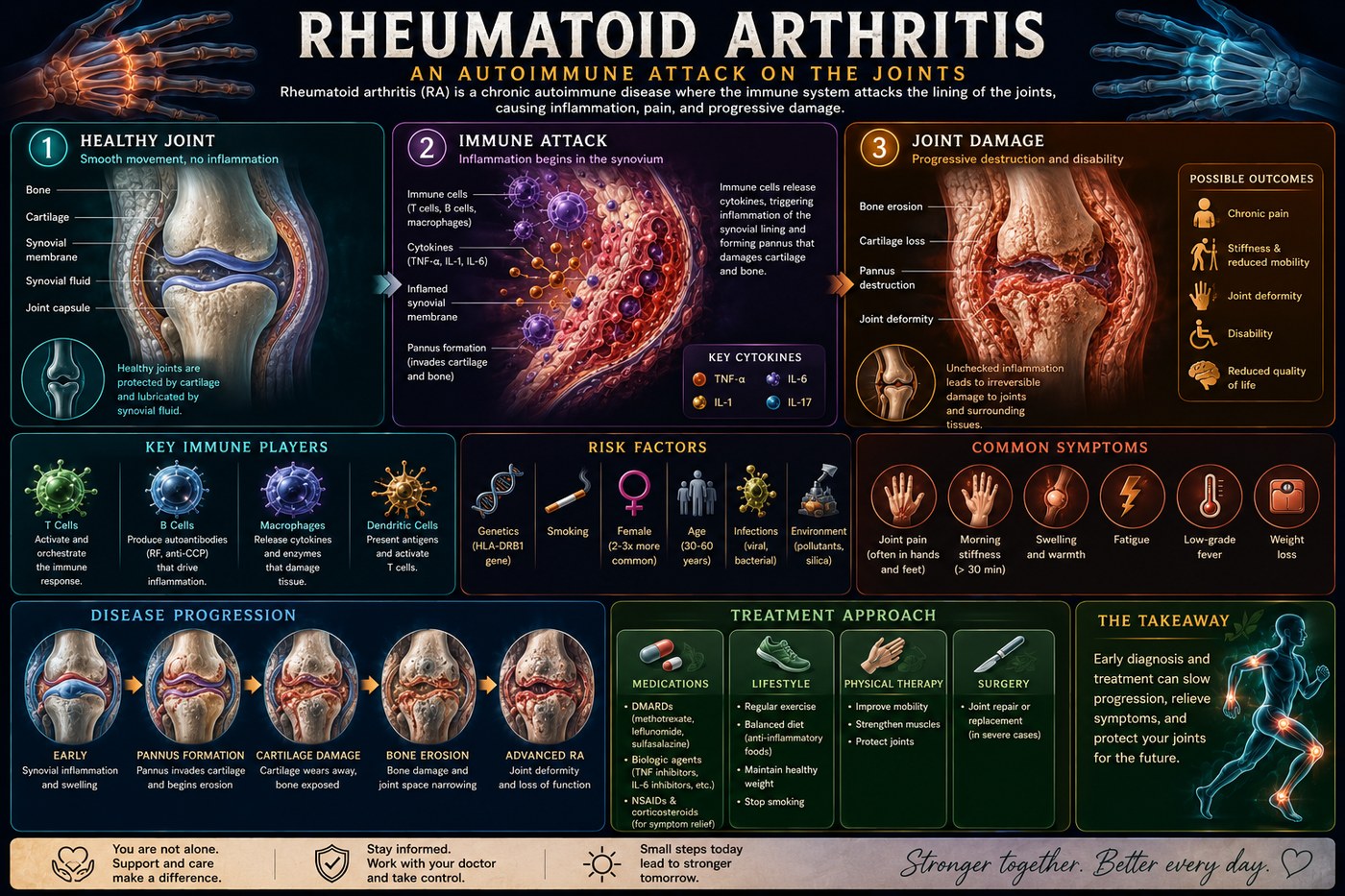
What is happening in the body
Rheumatoid arthritis begins not in the joint but in the systemic immune system. The disease is characterised by the production of rheumatoid factor (RF) and anti-citrullinated protein antibodies (ACPA) — antibodies that target citrullinated proteins, which are normal proteins altered by an enzyme called peptidylarginine deiminase. ACPA can appear in the bloodstream years before any joint symptoms, marking the period of immune system priming that precedes clinical disease.
Once the immune response is established, the synovium — the thin membrane lining joint cavities — becomes the target tissue. Macrophages, dendritic cells, and T-cells infiltrate the synovium, secreting TNF-alpha, IL-1, and IL-6, which drive a positive feedback loop of inflammation. The synovium proliferates pathologically, forming a mass of inflammatory tissue called pannus. Pannus is the destructive agent of RA: it invades cartilage and underlying bone, secreting matrix metalloproteinases and osteoclast-activating factors that dissolve both.
The result is progressive joint destruction — initially reversible through medication but ultimately producing the characteristic deformities of advanced RA: ulnar deviation of the fingers, swan-neck and boutonnière deformities, and loss of joint space visible on X-ray.
The symptoms this produces
- Symmetrical joint pain and swelling (both hands, both wrists simultaneously)
- Morning stiffness lasting more than an hour
- Systemic fatigue and low-grade fever
- Rheumatoid nodules under the skin at pressure points
- Gradual joint deformity if untreated
- Extra-articular manifestations: lung fibrosis, vasculitis, eye inflammation
- Anaemia of chronic disease
How this fits the autoimmune pattern
Citrullination of proteins in the gut — driven by dysbiosis, particularly by Prevotella copri overgrowth, which is consistently elevated in new-onset RA — is the suspected mechanism by which ACPA tolerance breaks. Porphyromonas gingivalis, the periodontal pathogen, produces its own citrullinating enzyme and is strongly linked to RA risk. Both gut and periodontal dysbiosis create systemic exposure to citrullinated antigens, priming the B and T cell response that later targets joint tissue through molecular mimicry.
What the clinical data shows
A child with juvenile idiopathic arthritis (the paediatric form of RA) is among the Paleomedicina published case series: joint swelling and pain resolved within weeks of initiating the Paleolithic Ketogenic Diet, and inflammatory markers normalised. Adult RA patients on PKD have reported significant reduction in disease activity scores. The mechanism is thought to involve removal of dietary lectins that trigger Prevotella and Porphyromonas activity, combined with the anti-inflammatory ketone body beta-hydroxybutyrate, which directly inhibits the NLRP3 inflammasome responsible for IL-1 beta secretion.
A life with this condition — Stories
Maya, 38. The first sign was her hands in the morning — both of them, which she later learned was important. One stiff hand might be an injury; both at once, mirror-image, was the immune system. She was an architect, and she began arriving an hour early to let the stiffness pass before she needed to use a mouse. Her anti-CCP came back strongly positive. The antibodies had probably been circulating for years before her joints became the target, forming against citrullinated proteins in a silent priming phase. She was told her disease had been active "for a while." Her hands, the tools of her profession, were the battlefield.
Robert, 55. His RA started in his feet, not his hands — a detail that delayed diagnosis by eighteen months because neither his GP nor his first rheumatology referral thought to examine his metatarsophalangeal joints. He had been told his forefoot pain was Morton's neuroma, then plantar fasciitis. It was only when both wrists became involved that the symmetrical pattern became undeniable. His X-ray showed erosions at the second and third MTP joints on both feet — damage that had already occurred during the months of misdiagnosis.
Layla, 29. She was one of the youngest patients in her rheumatologist's clinic with seropositive RA. Her anti-CCP titre was among the highest her rheumatologist had ever seen — a marker that predicted aggressive, erosive disease. She was started on methotrexate and a biologic within weeks of diagnosis, an urgency that surprised her. What her rheumatologist explained was that in RA, the window of opportunity for preventing irreversible joint damage is measured in months, not years. Every month of active synovitis was cartilage she would not get back.
Transcript witness — Dr. Anthony Chaffee podcast. A woman speaker describing her RA reversal: "I was an artist. I developed 28 nodules in my right hand within a month — a contracture of the hand called Dupuytren's — and while I was being treated for it, I was diagnosed with rheumatoid arthritis. Thirteen years later, all the nodules have disappeared. I have full use of my hand. When I found out about carnivore I thought it was absolutely insane. But there were randomised controlled trials. There were people like me who had gotten better. And now I am one of them."
McKayla Peterson — referenced on the Anthony Chaffee podcast. McKayla Peterson suffered with severe rheumatoid arthritis as a child, underwent two major joint surgeries, and later described achieving remission through a strict elimination diet. Her story drew significant attention to the possibility of dietary disease modification in RA — a possibility her rheumatologists had not raised as an option. Her father, Jordan Peterson, independently adopted a similar dietary approach for his own health conditions and reported comparable improvements.
Daria, 47. Her RA went into remission on methotrexate after two years, and she and her rheumatologist agreed to trial a slow taper. She tapered successfully to a lower dose and then — over her rheumatologist's caution — to zero, feeling well for eight months before her DAS28 score crept upward again at her routine check. She restarted methotrexate. Her rheumatologist told her that drug-free remission in RA is achievable but fragile, more likely in patients who are seronegative. Daria was strongly seropositive. The disease had not gone away; it had been suppressed, and it knew when the suppression lifted.
Victor, 63. He had RA for twenty-two years and remembered the exact moment the disease had decided to show him what it was capable of: a cervical spine subluxation requiring emergency stabilisation surgery. Longstanding RA erodes the ligaments of the upper cervical spine; his neurologist told him it was the most feared extra-articular complication of the disease. He had managed his joint disease well. He had not known to ask about his spine. Routine cervical screening in RA of his duration was now standard; it had not been when he was diagnosed.
Anya, 39. She had heard about a strict carnivore elimination diet from a friend and tried it without telling her rheumatologist, expecting it to make no difference. After three months her morning stiffness was gone. After six months her CRP was normal for the first time in four years. She told her rheumatologist, who was sceptical but reviewed her results. Her DAS28 score — a composite of joint tenderness, swelling, and inflammatory markers — had fallen from 5.1 to 2.3. Her rheumatologist said she had achieved low disease activity. She asked what had caused it. Her rheumatologist said they could not be sure. She was sure.