Exhibitionism: The Compulsion to Be Seen and the Wound Underneath
Exhibitionism is one of the most clinically misunderstood paraphilias — dismissed as perversion or reduced to legal category. The psychological literature, drawing on object relations, Jungian theory, and developmental research, tells a more specific story: a compulsion rooted in unmet recognition needs, distorted early mirroring, and the desperate attempt to resolve shame through the forced reaction of another.
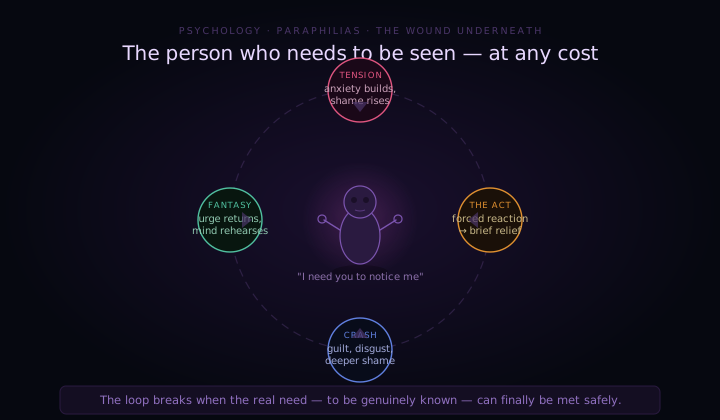
Most people hear the word "exhibitionist" and think: pervert. Creep. Someone broken in a way that doesn't need explaining, just punishing. But psychology asks a different question — not "what is wrong with this person" but "what happened to this person, and what are they actually trying to solve?"
The answer turns out to be surprisingly specific, and surprisingly human.
What the behaviour is really about
Here is the thing that most people miss: exhibitionism is not really about the exposure. It is about the reaction. The exhibitionist does not want admiration. He wants an involuntary response — shock, alarm, the moment when someone cannot pretend he isn't there.
That distinction matters enormously. Because it tells us what the behaviour is actually trying to accomplish. It is not sex in the ordinary sense. It is a desperate, compulsive attempt to exist — to produce undeniable proof that he has an effect on the world.
Why would someone need that kind of proof? That is where the real psychology begins.
The wound that comes first
Long before the behaviour, there is usually a child who did not feel seen.
Not dramatically neglected, necessarily. Sometimes just a parent who was preoccupied, depressed, or too caught up in their own emotions to reliably notice their child's inner world. When you look at your parent's face and you see their worry instead of a reflection of you — when your excitement, your distress, your needs consistently fail to land — you learn something at a very deep level: your existence is uncertain. You are not sure you register.
Most children get enough of this mirroring that the need eventually quietens. They grow up with a stable enough sense that they exist, that they matter, that they can be seen. That need for visibility gets met through ordinary friendship, love, work, recognition.
But when the early mirroring was consistently absent or distorted, the need does not go away. It goes underground — and it tends to come back in a distorted form.
The role of shame
Shame is different from guilt. Guilt says: I did something wrong. Shame says: I am something wrong.
People with exhibitionistic compulsions almost always carry an unusually heavy load of shame — a deep, often wordless conviction that they are inadequate, invisible, or defective. The shame usually has roots in the same early experiences: being humiliated, being made to feel their body or emotions were disgusting, being consistently made to feel small.
Here is the cruel paradox: shame is fundamentally about being seen badly. And the response to that shame — the compulsive behaviour — involves being seen in the most confronting way possible. It sounds irrational. But at some archaic level in the nervous system, being seen as monstrous is less frightening than not being seen at all. Any powerful reaction confirms: I exist. I have an effect. I cannot be ignored.
The loop that takes over
Once the behaviour starts, it follows a remarkably consistent cycle — one that tightens over time, like an addiction.
Stage 1: Tension builds. Something triggers the underlying shame — a setback, a rejection, a moment of feeling invisible. Anxiety rises. The person cannot name what they're feeling, but the pressure increases.
Stage 2: Fantasy and planning. The mind starts rehearsing. The fantasy provides temporary relief — but it also escalates the urge. The planning feels, paradoxically, like relief from the pressure.
Stage 3: The act. Clinical descriptions consistently note that this feels driven, compulsive — like being carried by something outside deliberate choice. The reaction from the other person produces a brief, intense feeling of impact. Power. Existence confirmed. Tension released.
Stage 4: The crash. Almost immediately: shame, self-disgust, horror at what was done. But here is where the trap tightens — this crash feeds directly back into the original wound. The person proves to themselves, again, that they are defective. The shame builds. The cycle starts over.
Over time, the cycle shortens and the behaviour escalates. The relief gets briefer. The shame gets heavier. The person becomes increasingly unable to stop, even when they desperately want to.
Why a willing partner doesn't fix it
One detail clinicians consistently note: exhibitionists are not interested in consensual exposure, even when it's available. This puzzles people — if the behaviour is sexual, why wouldn't consent solve it?
Because consent removes the entire psychological point of the act. What the behaviour is organised around is the forced, involuntary reaction — the evidence that the impact is real and cannot be managed by the other person. A willing partner can simply look away or not react. That option doesn't exist with a stranger in a public place.
This tells us that the behaviour is not really about sexuality in the ordinary sense. It is about power and visibility — about producing an undeniable effect in a world that has felt, since childhood, indifferent to their existence.
The shame underneath the confidence
From the outside, you might expect an exhibitionist to seem like someone with too much confidence — someone who thinks the world wants to see them. The opposite is almost always true. Clinical psychology consistently finds that underneath the compulsive behaviour is a profound sense of inadequacy.
This is what makes it similar to a particular kind of narcissism — not the loud, self-aggrandising kind, but the quiet, covert kind. The person who needs constant confirmation because inside they are not sure they deserve to exist. The grandiose surface is a cover for the wound underneath.
The behaviour is, in a twisted way, the only solution the person has found that reliably produces the feeling — even briefly — of existing fully and undeniably in someone else's experience.
What actually helps
Treatment works. That surprises people, but the evidence is clear: with the right support, the compulsion can be interrupted and the underlying wound can begin to heal.
The part that doesn't work is simply trying to suppress the behaviour without addressing what drives it. That is like putting a lid on a pressure cooker without reducing the heat. The urge will find another outlet, or the person will simply become more secretive.
What does work is a combination of two things.
First, learning to recognise and tolerate the internal states that precede the compulsion — the shame, the anxiety, the building pressure. Most people with this compulsion have almost no contact with those feelings; the behaviour short-circuits them before they can be consciously experienced. Therapy builds the capacity to sit with those states long enough to understand what they are and where they come from.
Second, and more fundamentally: building the thing that was missing at the beginning. A stable enough sense of self that the person no longer needs forced external confirmation. Genuine relationships in which they can be known slowly, voluntarily, over time — the thing that the compulsive behaviour is a broken substitute for.
The need to be seen is not the problem. It is one of the most basic human needs. The problem is that this person never found a safe way to meet it — and the compulsion became their only available answer to a question that had no other outlet.
The thing worth understanding
What psychology tells us about exhibitionism is not that it should be excused. The harm it causes to victims is real — the intrusion, the fear, the lasting disruption of feeling safe in public. Nothing in the psychological account removes that harm.
But understanding the psychology matters — because it is the difference between a response that simply punishes and a response that actually interrupts the cycle. And because it reveals something that applies, in smaller and less destructive forms, to experiences most people recognise: the need to be seen, to matter, to exist in someone else's awareness. The need that, when it cannot be met safely, tends to express itself in the only way it can find.
The loop breaks — not through suppression, not through shame piled on shame — but when the original need can finally be met in a way that is real.