Why You Feel Empty: Gabor Maté on the Hungry Ghost and the Void Inside
The feeling of inner emptiness — the sense that nothing quite fills you, that you are always reaching for something just out of reach — is one of the most common and least talked-about forms of suffering. Gabor Maté traces it to a specific wound: the disconnection from self that begins in childhood, and the lifelong attempts to fill from the outside what was never nourished from within.
Most people who feel empty don't call it that. They call it restlessness, or boredom, or the vague sense that something is missing — that life should feel more substantial than it does. They scroll more, eat more, work more, fall into relationships that don't satisfy them, and find that none of it touches the feeling. The emptiness persists beneath whatever they pile on top of it.
Gabor Maté has spent decades sitting with people for whom this emptiness became unbearable enough to drive addiction. His explanation of where the feeling comes from is one of the most clarifying things he teaches.
The hungry ghost
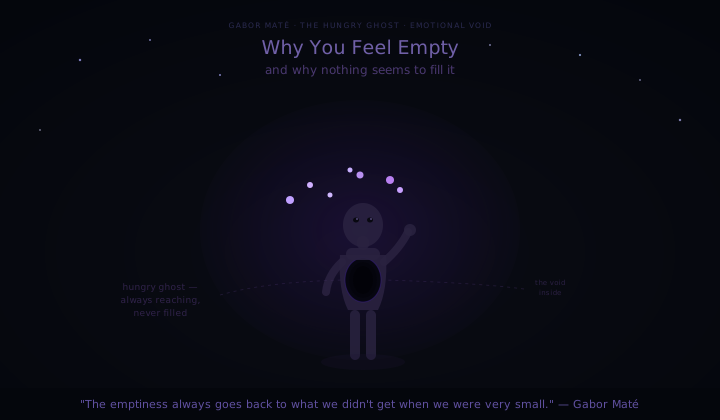
Maté returns often to a Buddhist image: the hungry ghost. "The hungry ghosts are creatures with large empty bellies and small, scrawny necks and tiny little mouths, so they can never get enough, they can never fill this emptiness on the inside. And we are all hungry ghosts in this society, we all have this emptiness, and so many of us are trying to fill that emptiness from the outside — and the addiction is all about trying to fill that emptiness from the outside."
The image is precise. It is not that addicted people — or people in the grip of any compulsion — are getting the wrong thing. It is that the mechanism itself is broken: whatever goes in cannot reach the place that is empty. The belly stays large. The need stays unmet.
And the cause, Maté says, is not complicated once you look at it directly: "The emptiness always goes back to what we didn't get when we were very small."
What creates the void
The void is not random. It has a specific origin in childhood, in what happened to the emotional life of a person when they were at their most dependent and most impressionable.
Maté traces it through his own experience. Born in Budapest in 1944 to Jewish parents, he entered the world during the German occupation. "The day after they did, my mother phoned the pediatrician and she said, 'Would you please come and see Gabor because he is crying all the time.' And the pediatrician said, 'Of course, I will come to see him, but I should tell you, all of my Jewish babies are crying.' Now why? What do babies know about Hitler or genocide or war? Nothing. What we were picking up on is the stresses and the terrors and the depression of our mothers — and that actually shapes the child's brain."
The consequence, as he came to understand it: "I get the message that the world doesn't want me, because if my mother is not happy around me, she must not want me." The feeling of unwantedness does not announce itself clearly — it settles as a background state, a permanent slight deficit in the sense of being welcome in the world. And from that deficit grows the hunger.
The void in adult life
Maté is unusual in applying this framework to himself as directly as he applies it to his patients. He describes what happens when he returns from speaking tours: "When I go on speaking trips and I speak to hundreds of people — I speak to a couple thousand people — and then I go home and I feel a kind of emptiness. Well, that's my addictive side, even though when I was there I spoke the truth and I helped people and people were inspired and grateful. I get home and I'm irritable and empty — that's because I'm needing that to fill me. And that's an addictive relationship to work."
The external event — the speaking, the applause, the impact — does not fill the emptiness. It temporarily covers it. When it stops, the void reasserts itself. This is the pattern: not that people are broken, but that they are using the outside to medicate a wound that only began inside.
Addiction as spiritual starvation
On the spiritual level, Maté describes addiction as "an emptiness and a disconnect — not from belief, but from faith. And a lot of people with addictions have all kinds of religious beliefs but they have no faith whatsoever, because as soon as you have faith, what does that mean? It means that you're connected to source, in which case why do you need to add anything else to that? So genuine faith precludes addiction, and addiction means that there's no faith."
He makes the same point about dislocation: "Addiction is very much a modern phenomenon, and it has to do with dislocation — so when people are dislocated from that connection to themselves, from that connection to tribe, to culture, to clan, to society, from their land, from their home — that's when addictions happen."
The emptiness, in other words, is not personal failure. It is what happens to a human being whose fundamental needs for connection — to self, to others, to meaning — have not been met. In a culture structured to maximise output and minimise stillness, that disconnection is almost universal in degree, even if most people never reach the extreme of clinical addiction.
The loneliness underneath
Maté connects the inner emptiness directly to loneliness — not just the loneliness of being alone, but the loneliness of not being known. "We are social beings. When we feel disconnected or alienated, we experience pain. Addiction, depression, anger, and violence are different ways we react to pain."
He notes that self-reported loneliness is rising sharply across the developed world. This is not coincidental: as communities fragment, as work demands expand, as the built environment makes casual human contact rarer, the conditions for chronic inner emptiness multiply. The hungry ghost multiplies with them.
Why filling from the outside doesn't work
The core of Maté's explanation is that the emptiness was created by a disconnection from self — and things from the outside cannot repair a wound that exists on the inside. Food, work, sex, screens, substances, status — none of these reach the place that is empty, because that place is not a hole that can be filled with content. It is the absence of connection to your own interior life.
"In addiction there's always significant emotional and psychic pain. Addiction is always an attempt to escape from pain based on life experience when we were vulnerable and helpless and small. It is also an expression — as a result of that really pain — of having become disconnected from our sense of unity and wholeness. So there's a spiritual void. The addiction is an attempt to somehow satiate and fill that spiritual void."
The attempt fails not because the person is weak. It fails because the thing being sought — connection, fullness, being at home in oneself — cannot arrive from an external source. "We have to find that light within ourselves," Maté says, "we have to find the light within communities and in our own wisdom and our own creativity."
What the emptiness is actually asking for
The emptiness is not the problem. It is a signal. It points toward what was missed — the attunement, the felt sense of being wanted and seen, the freedom to be fully present in one's own emotional life — and it keeps pointing until those things are addressed rather than circumvented.
The healing, in Maté's framework, is not about filling the void but about understanding its origin and reconnecting with what was disconnected. That means tolerating the emptiness long enough to ask what it is pointing at — and being willing to discover that the answer is not somewhere outside.