Enduring Life's Darkest Moments: Peterson on Meaning, Suffering, and How to Keep Going
Peterson does not pretend that life is safe or fair. His consistent message is that suffering and malevolence are real and undeniable — but that a sustaining meaning, anchored in responsibility and aimed upward, is what makes those things bearable. He has lived this himself.
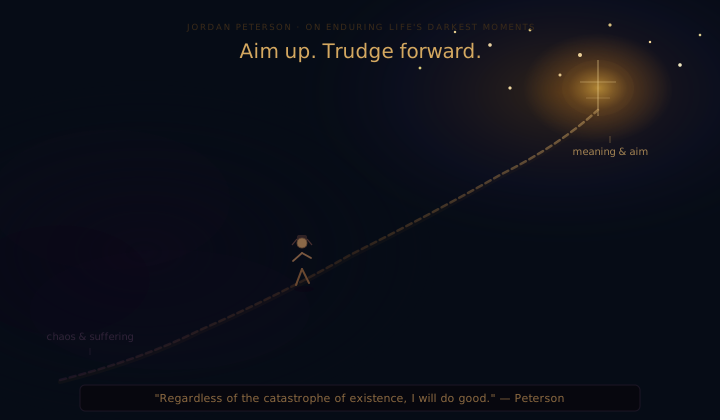
Most self-help tells you that if you just think the right thoughts, feel the right feelings, and follow the right system, hard times will pass quickly and life will return to pleasant. Jordan Peterson does not say that. He says something harder and more honest, and because of that, something more useful.
"Life is suffering and malevolence in its essence, in some undeniable sense," he says. "It may not be only that — but it is undeniably also that."
The question is not how to avoid the hard parts. The question is: what lets a person carry them?

Why meaning is not optional
Peterson draws on both Buddhism and Christianity to make a point that cuts across religion: pain is real. "For the Buddhists, the fundamental maxim is that life is suffering. And it seems to me there's a metaphysical claim there — the metaphysical claim is that pain is real. People act as if their pain is real. That's a good place to start."
And he goes further. "You can be broken, hurt, and destroyed. That seems pretty self-evident. And worse — you know it. That's what separates us in some sense from other creatures. Real self-consciousness is the knowledge of your borders — not only in space but in time."
This matters because it rules out a certain kind of false comfort. You cannot talk yourself out of genuine suffering by pretending it isn't real. The path through has to be honest about what it is passing through.
And the mechanism Peterson returns to again and again is meaning: "You need a sustaining meaning to tide you over while you're suffering and while you're betrayed."
In the absence of that: "The tragedy and betrayal that inevitably accompany life undermines motivation, engendering a suffering that can be unbearable — and tempting us all toward hedonism, cynicism, hopelessness, bitterness, envy, and ultimately the delights of vengeful cruelty."
Without a meaning that can outlast the storm, the storm wins.
Where people actually find meaning in crisis
Peterson has observed something consistent about how people behave when things fall apart — not in theory, but in practice. "If you watch people, if you watch how people actually respond in times of crisis, they find that the responsibilities they've undertaken in the past — to form friendships, to form intimate relationships, to clean up their family and establish tight bonds, to take on some major burden and make sacrifices in their life — that's where they get all the meaning."
This is the answer to the question of what to do when everything seems to be collapsing: go toward responsibility, not away from it. The person who has something real to care for — a child, a marriage, a project they have genuinely committed to — has a rope that holds them even when the ground gives way.
"Worthwhile meaning in your life is going to be found in the voluntary adoption of responsibility," he says. "Voluntary self-sacrifice — that's the spirit of the functional psyche, family, and community."
This is counterintuitive, because when life becomes difficult, the first impulse is often to shed commitments, simplify, retreat into comfort. But Peterson's observation is that the commitments are not the weight — they are the ballast.
The upward aim
Peterson talks about what he calls the "upward aim" — the idea that a person orients themselves toward something above their current condition, and maintains that orientation even when circumstances are crushing.
"You're called upon to maintain your upward aim regardless of the catastrophe of life. And the promise is that if you do that voluntarily, the spirit of the cosmic order will walk with you while you do it."
He connects this to a practical psychological reality: "We know practically, we know psychologically, that you become braver and better with every decision you make to confront what obstacle terrifies you and stops you in your tracks. You develop into more of what you could be by constantly confronting the things that challenge you most deeply."
This is not the logic of positivity. It is the logic of the hero in myth — the figure who descends into the worst possible situation and emerges changed, because they chose to face it rather than flee it.
Suffering for a purpose is different
Peterson draws a distinction that most people miss: the kind of suffering that crushes you, and the kind that transforms you. The difference is not the intensity. It is whether the suffering is attached to something meaningful.
"If you suffer for purpose, that suffering actually ceases to be suffering in the way that we understand it," he says. "No burden, no adventure. No adventure, no meaning."
This tracks with what people discover after they have been through the worst: the difficulty itself is often not what they would choose to undo. It is when the difficulty had no point, no connection to anything they valued, that it leaves them empty. The difficulty that was wrapped around something real — raising a child, completing a creative work, keeping a promise — often becomes something they would not trade.
Pick up your cross and stumble uphill consciously, he says. The word "consciously" matters. Not blindly, not because you have no choice, but because you have chosen to bear it and you know why.
What faith in dark times actually means
Peterson uses the word faith in a specific way that doesn't require you to have resolved any theological questions. He means something like: committing to the upward aim even when you cannot see the evidence that it will work out.
"Should you aim up or down? That's not a question you can answer by sifting the evidence. And that's where the element of faith comes in — regardless of the catastrophe of existence, I will do good."
He also puts it in terms of truth-telling: "There is no difference between speaking the truth and having the adventure of your life. Those are the same thing. And whatever happens to you if you speak the truth is the best thing that could happen under those circumstances — regardless of how it looks to you in the moment."
"Your momentary view isn't omniscient. Imagine you suffer for three weeks and then things are really good for a year because of it. Those three weeks are still going to be miserable, and if you used your judgment then, you'd think, 'Oh god, this is a complete catastrophe.' But you don't have that longer-term view. I think faith in the redeeming power of the truth is equivalent to the longest possible term view."
Gratitude in the midst of catastrophe
Peterson discovered something his own dark years taught him about the relationship between gratitude and survival. He does not hide what those years were: "I was so ill and was wishing that things would just come to an end for years."
His advice, from that place, is not cheerful. It is not easy. But it is specific: "Practice your gratitude even in the midst of catastrophe and aim up and trudge forward."
Practicing gratitude is different from feeling it. You can feel miserable and still deliberately remember and search for what remains worth something. "To practice gratitude means you remember what you're grateful about and search for it genuinely every day or every moment."
He adds: the people around you who do not lose faith — who keep believing you will pull through even when you no longer do — matter more than any strategy. "The fact that you and your mom didn't lose faith when I was so ill... That was certainly a huge part of what got me through it."
Welcome the unknown
There is a line Peterson returns to that reframes what the darkest periods actually are. "Welcome the unknown with open arms because it can teach you and change you into what you could be."
When the structure of your life collapses — the relationship ends, the career path fails, the diagnosis changes everything — what you are left with is the unknown. The instinct is to hate it. The alternative Peterson points to is to treat it as a territory full of information about who you can become, rather than a void that has taken what you had.
And in the darkest moments — Jonah in the belly of the whale, the man at rock bottom — there is often the sense of something larger than circumstance present. "When I read that I felt this overwhelming sense of there's someone here — there's something bigger than me that's right here in my darkest moment with me that knows what's happening."
What to do now
Peterson's framework for surviving and ultimately transcending dark periods is not a step-by-step program. But it has a shape:
Accept that suffering is real and that life contains genuine malevolence — not as pessimism, but as honesty. Without that acceptance, you are constantly blindsided.
Find or renew a sustaining meaning. It does not have to be grand. It is most often found in responsibility — something or someone you have committed to caring for.
Maintain the upward aim. Orient toward what you are trying to become or build, even when circumstances make it impossible to move toward it quickly. The orientation matters even before the movement.
Bear your suffering consciously. The difference between being crushed by what you carry and being formed by it is whether you have chosen to carry it, and whether you know why.
Practice gratitude. Actively search for what is still worth something. Do this even when — especially when — it feels false at first.
Trudge forward. Not sprint. Not transform overnight. Trudge: keep going, with honesty about the difficulty and a clear enough sense of direction to take the next step.
Peterson's message to people in the worst situations is not that things will definitely improve on the timeline you want, or that the difficulty you are in is not as bad as it seems. His message is more uncomfortable and more useful than that: you can become something by going through this, if you face it directly and do not abandon what you believe to be good. And that is not nothing. In many people's experience, it is everything.