Integrating Your Shadow: Peterson and Greene on the Dark Half
Two thinkers from different traditions — a Jungian clinical psychologist and a writer on power — converge on one prescription: the part of yourself you most want to disown is the part you most need to face. What the shadow is, why repression backfires, and what integration actually looks like.
Two very different thinkers — one a Jungian clinical psychologist, the other a writer on power and human nature — arrive at nearly the same prescription from opposite ends of the intellectual map. Jordan Peterson, steeped in clinical practice and the mythology of the heroic individual, and Robert Greene, anatomist of social manipulation and the darker arts of influence, both insist on a counterintuitive truth: the part of yourself you most want to disown is the part you most need to face. Not to indulge it, but to integrate it. What follows is a synthesis of their shared insight — what the shadow is, why the standard strategy of repression fails, and what the harder work of integration actually requires.
What the shadow is
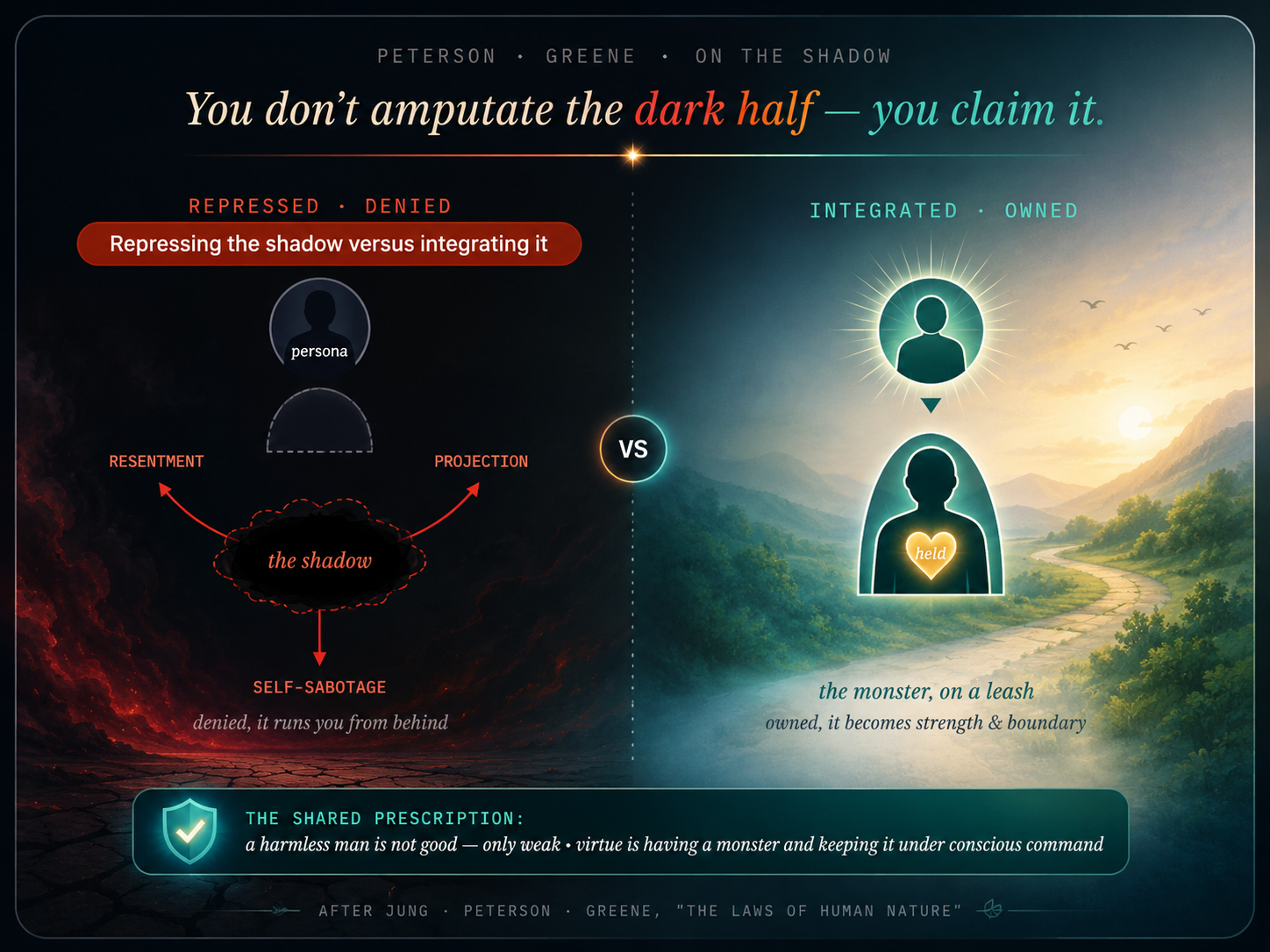
The term comes from Carl Jung, who used it to describe the sum of everything about yourself you have decided is unacceptable. The cruelty, the rage, the envy, the aggression, the capacity for harm — all of it relegated to the unconscious because it does not fit the image you wish to present to the world or to yourself. The shadow is not evil per se; it is disowned. It forms early, shaped by what your family and culture punished, by what earned you rejection or shame as a child. As Greene describes it, you learn quickly: "Robert, you can't hit people in school, stop that, don't be like that." The impulses do not vanish; they go underground. The key claim shared by both thinkers is this: the shadow does not disappear when denied. It goes underground and operates without your awareness, leaking out in ways you cannot see and would not admit.
Peterson's reading · the dangerous, controlled man
Peterson's clinical and Jungian framing begins with a claim that sounds paradoxical until you sit with it: a harmless person is not virtuous, merely ineffectual. Virtue, he argues, requires having a monster inside and keeping it on a leash. The person who cannot access their own aggression cannot set boundaries, cannot defend what matters, becomes a doormat — and a doormat, Peterson insists, is often seething with resentment underneath, which is its own kind of malevolence. Integration means knowing what you are capable of, including the worst, and choosing not to do it. He returns repeatedly to a Solzhenitsyn-adjacent insight: the line between good and evil runs through every human heart, and the person who denies their capacity for evil is the most dangerous of all. Peterson's example of his old roommate who worked with delinquents is instructive — the man was effective precisely because "there were no tricks they could get up to that he couldn't see right through," because he had a real integrated shadow. He was not naive. He had met his own darkness and could therefore recognize it in others without flinching.
Greene's reading · the repressed self leaks out
Greene approaches the same terrain from the side of social performance and the construction of persona. In The Laws of Human Nature, he frames the shadow as the traits we suppress to fit the social role, the carefully curated self we present at work, at school, in polite company. His clinical observation: repressed traits do not stay put. They leak out — in passive aggression, in projection (accusing others of your own faults), in sudden out-of-character outbursts, in self-sabotage. The more rigid and "nice" the persona, Greene warns, the more violent the leak. "We have to be so politically correct, we have to be so pleasant and smiling," he notes, and the pressure to maintain that facade ensures the dark energy will find another outlet. Greene's prescription is to get to know your shadow, to reintegrate its energy. The creative, the bold, the assertive, the willing-to-offend — these live in the shadow too, not only the cruel. Integrating the shadow is partly how you become more original and more powerful, not just less repressed. It is how you stop being controlled by forces you refuse to acknowledge.
Why repression fails
Both thinkers agree: the standard strategy — be good, be nice, suppress the dark — backfires. Energy denied does not vanish; it distorts. Peterson's resentment; Greene's projection and leakage. The over-controlled person is brittle; the perfectly nice person is often the one with the most hidden contempt. Greene puts it plainly: "Denying that you're manipulative, denying that you don't control yourself, means that you are being controlled, means you are being manipulated." The inability to access aggression is not the same as not having it. What you cannot see in yourself, you cannot govern. And what you cannot govern will govern you.
What integration actually looks like
The practical synthesis is this: integration is not acting out the shadow — not becoming cruel, not indulging the dark. It is the harder middle path: acknowledging the capacity, feeling the impulse without being driven by it, and channeling its energy toward chosen ends. Concrete moves both thinkers point toward: notice what you judge most harshly in others, because it is often your own shadow projected outward; notice your fantasies and what they reveal about what you have buried; develop the capacity to say no, to be disagreeable when it matters, to access controlled aggression in service of something you value. Peterson suggests writing it down; Greene urges studying your own past behavior honestly, without the comforting veil of self-justification. The goal is not goodness in the shallow sense. The goal is wholeness. As Greene observes, the only way to escape negative emotions — envy, resentment, anxiety — is to admit they are in you. Denial is not protection; it is admission by another name.
The harmless man, and the integrated one
The closing argument both thinkers share returns to Peterson's opening gambit: the harmless man is not good; he is weak, and his weakness curdles into something bitter and small. The genuinely good person is the one who has met their own darkness, knows exactly what they could do, and holds it under conscious command. That person is formidable and trustworthy at once — formidable because the capacity is real, trustworthy because it is governed. Integration is the difference between a man who cannot hurt you and a man who could but chooses not to. Greene's Kobe Bryant example is apt: the basketball great admitted he had "a lot of dark energy, a lot of anger," and he channeled it into relentless competitiveness. He did not pretend it away. He used it.
Two thinkers, two traditions, one conclusion: you do not become whole by amputating your dark half, but by claiming it. The shadow integrated is not a liability; it is a source of strength, boundary, and depth. The work is uncomfortable, lifelong, and worth it.