The Brain Behind the Personality: Sapolsky on Structure and Behavior
What we call personality is, in large part, the relative strength of a handful of brain structures. A tour through Sapolsky's account — the prefrontal brake, the amygdala alarm, the dopamine engine of wanting, the stress-scarred hippocampus — and how their balance becomes a temperament.
Personality can feel like something essentially abstract—a soul, a self, a character, the indefinable you that persists beneath the surface. Robert Sapolsky's lectures dismantle that intuition gently, showing that what we call personality is, in large part, the relative strength and wiring of a handful of brain structures. There is no homunculus, no little person inside choosing; there is the brain, doing what its structure inclines it to do. What follows is a tour of the regions that make us who we are—the brake, the alarm, the engine of wanting, the scar of stress—and how their architecture becomes the architecture of a person.
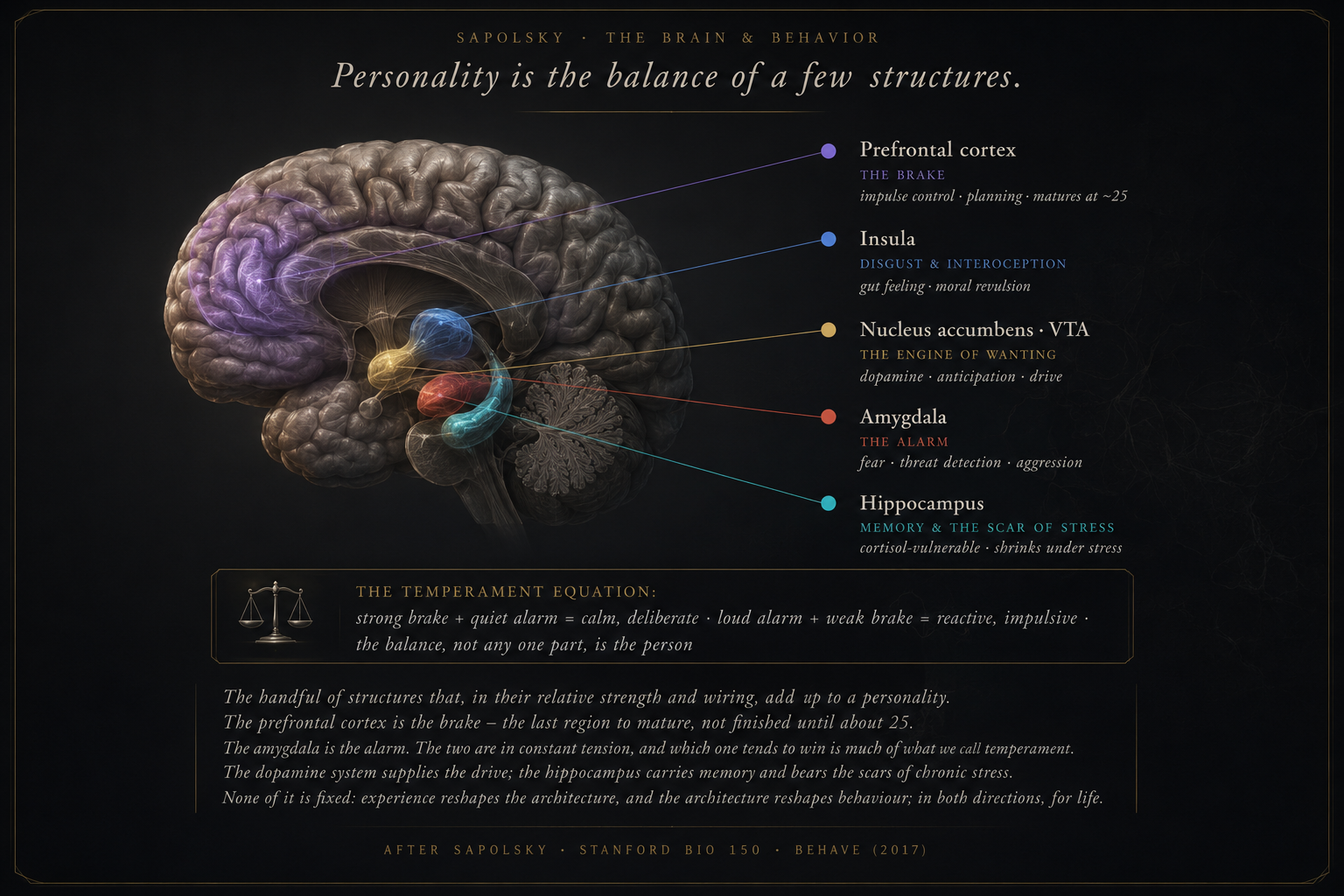
The prefrontal cortex · the brake
The prefrontal cortex sits behind the forehead, the last part of the brain to develop and the first to be consulted when you face a choice between the easy thing and the right thing. It is the region responsible for impulse control, long-term planning, and what Sapolsky describes as making you "do the harder thing when the harder thing is right." The PFC is the seat of executive function—of pausing, weighing consequences, overriding temptation. Crucially, it does not finish maturing until around age twenty-five, which explains much about adolescent behavior: the risks taken, the futures discounted, the brake not yet fully installed. Personality correlate: conscientiousness, self-regulation, future orientation. The most famous case of prefrontal damage is Phineas Gage, the railroad foreman whose frontal cortex was destroyed by a tamping iron in 1848. He survived, his intelligence and memory intact, but his personality changed utterly—impulsive, profane, unreliable. "No longer Gage," his friends said. The self, it turned out, was tissue.
The amygdala · the alarm
Deep in the temporal lobe lies the amygdala, an almond-shaped structure that specializes in fear, threat detection, and reactive aggression. It fires before you are consciously aware of danger—before you know why your heart is racing or your hands are clenched. Sapolsky emphasizes that an overactive amygdala produces anxiety, hypervigilance, and a hair-trigger for violence. The amygdala is the alarm system, scanning constantly for what might go wrong. Personality correlate: neuroticism, threat sensitivity, the tendency to startle easily and trust cautiously. The amygdala and prefrontal cortex are in constant negotiation—the alarm versus the brake. When the PFC sends inhibitory signals down into the amygdala, fear can be extinguished, reappraised, calmed. Cut that projection, and extinction fails; the alarm keeps ringing. The balance between these two regions—how loud the amygdala, how strong the prefrontal override—shapes much of what we call temperament.
The dopamine system · the engine of wanting
The ventral tegmental area and nucleus accumbens form the core of the brain's dopamine system, and here Sapolsky offers one of his most clarifying insights: dopamine is not about pleasure. It is about anticipation—the wanting, not the having. Dopamine surges in pursuit, in the moment before reward, in the gap between effort and attainment. This is why the chase feels better than the catch, why slot machines are more compelling than certainties. Sapolsky notes that dopamine peaks highest when reward is probable but not guaranteed—when there is uncertainty, hope, the chance of something good. This system drives motivation, persistence, addiction, restlessness. Personality correlate: drive, novelty-seeking, the inability to sit still. A hyperactive dopamine system produces someone always leaning forward, always chasing the next thing, never quite satisfied. The engine runs hot, and satisfaction is always just ahead.
The hippocampus · memory, and the scar of stress
The hippocampus is a seahorse-shaped structure that consolidates memory, turning experience into something retrievable. But it has a special vulnerability: it is dense with receptors for cortisol, the primary stress hormone. Chronic stress floods the hippocampus with glucocorticoids, and over time, this damages neurons, shrinks the structure, impairs memory. Sapolsky's signature research focused on this mechanism—how prolonged stress leaves a physical scar. The hippocampus does not just store the past; it is reshaped by it. When the hippocampus is compromised, the brain shifts toward a more reactive, amygdala-dominated mode—less able to contextualize threat, more likely to see danger everywhere. The personality consequence: anxiety becomes entrenched, memory becomes fragile, and the past weighs heavily on the present.
The tug of war that makes a temperament
Personality is not located in any one region. It emerges from the relative balance between them—the tug of war, the shifting dominance. A strong prefrontal cortex over a quiet amygdala produces a calm, regulated, deliberate person. A loud amygdala over a weak PFC produces someone reactive, anxious, impulsive. A hyperactive dopamine system produces a driven, restless seeker; a sluggish one, apathy and anhedonia. These are not fixed types. They are tendencies, set by genes, sculpted by early development, and tuned moment to moment by hormones, context, and circumstance. Sapolsky's framing cuts through: there is no ghost in the machine, no chooser standing apart from the choices. There is the brain, with its particular wiring, doing what it was built to do. The architecture dictates the outputs. What we experience as character is the emergent property of these regions negotiating with one another, second by second, for control.
How experience rewrites the architecture
But the brain is not fixed hardware. Neuroplasticity means the structure itself changes in response to experience. Chronic stress enlarges the amygdala and shrinks both the prefrontal cortex and hippocampus, tilting the whole system toward threat and away from regulation. Early-life adversity recalibrates the brain, setting the alarm louder and the brake softer. Conversely, learning and practice thicken the regions you use—musicians' auditory cortices, taxi drivers' spatial maps, meditators' attentional networks. Sapolsky's point: the structure shapes behavior, but behavior and environment, over time, also reshape the structure. The arrow runs both ways. This is why intervention matters, why therapy and safety and repetition can shift not just thoughts but the tissue underneath them. The brain you have shapes the person you are, but the life you live reshapes the brain.
What Phineas Gage taught us
In 1848, a railroad foreman named Phineas Gage survived an explosion that drove a three-foot tamping iron through his prefrontal cortex. He walked, talked, remembered his name and his past. His intelligence was intact, his language unaffected, his memory clear. But his personality had vanished. The careful, responsible man became impulsive, profane, unreliable—"no longer Gage," as those who knew him said. This was the first clear demonstration that personality lives in tissue, that damage to specific regions damages the self in specific ways. Sapolsky returns to Gage often, as the cleanest proof that there is no separate soul animating the brain. The self is the brain. Destroy part of it, and you destroy part of the person.
None of this makes personality less real, or less yours. It makes it physical, and therefore understandable, and therefore—within limits—changeable. The brain you have shapes the person you are; the life you live reshapes the brain. Sapolsky's lectures are, in the end, an argument for humility and for compassion: about yourself, running machinery you did not choose, and about everyone else running the same.