How to Live a Meaningful Life: Peterson on Aim, Responsibility, and Why Meaning Beats Happiness
Happiness is unreliable, fragile, and frequently absent when you need it most. Meaning is something else entirely — it is the sense that what you are doing and suffering is worth it. Peterson argues that meaning is not found by seeking it directly, but by voluntarily picking up a load: setting an aim, accepting responsibility, and standing at the edge between order and chaos with your eyes open.
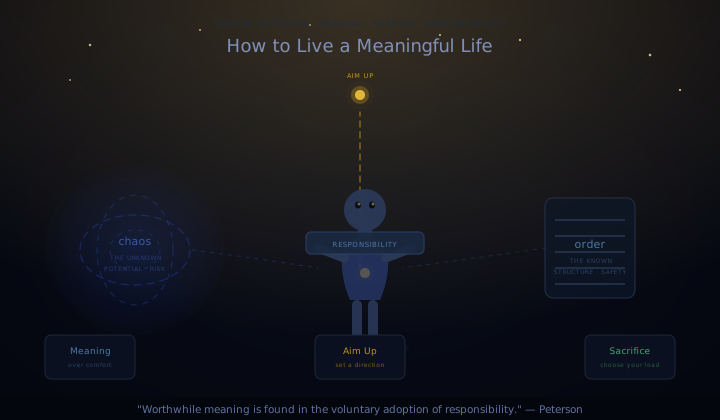
Most people, when they think about what they want from life, land on happiness. Peterson's consistent position is that this is the wrong target — not because happiness is bad, but because it is not stable enough to organise your life around. Happiness comes and goes. It is a byproduct, not a foundation. The thing that can actually sustain a human being through difficulty, failure, and loss is meaning — and meaning has a different source.
Why you cannot live without meaning
"If you really understand that meaning is the signal of optimised transformation, then you're immune in some ways to the corrosive nihilism that says, at its core, life has no meaning." The person without meaning is not just unhappy — they are exposed. They have no reason to get up, no direction to move in, no criterion by which to make decisions. Without meaning, Peterson says, everything becomes equally arbitrary, which is not liberation but paralysis.
The nihilistic position — that nothing ultimately matters, that existence is fundamentally meaningless — does not stay neutral. It curdles into resentment, bitterness, and eventually into destructiveness. People who cannot find a reason for their suffering will find a target to blame for it. The move from meaninglessness to resentment is not random. It is what happens when the fundamental human need for a sense of worth and direction goes unmet.
"The idea of love is that despite its suffering and malevolence, the world is worth supporting and working to improve. That's a real tough commitment. Because to the degree that your life is tragic and contaminated by malevolence, it can make you bitter and resentful and destructive." The alternative to meaning is not comfort — it is bitterness.
Meaning is found at the border between order and chaos
Peterson's framework for understanding where meaning lives draws on ancient symbolic structures. There is order — the domain of what is known, structured, predictable. There is chaos — the domain of what is unknown, unpredictable, potentially transformative. Both are necessary. Pure order without chaos is stagnation; pure chaos without order is dissolution.
"Chaos is also the domain of potential. Because in the things you don't understand is the possibility of new knowledge, right? New ways of conceptualising the world and new discoveries about your own nature." Meaning lives not inside the comfort zone of what you already know, but at the edge — where you are confronting something that challenges you, where you have to grow to meet it.
"How you conceptualise the stance you take in relationship to the domains of chaos and order — that's about the most important decision you ever make." The person who hides entirely in order — who never risks, never ventures into the unknown — is safe but empty. The person who lives in pure chaos has no ground to stand on. The meaningful life is one lived at the border: structure sufficient to stand on, and enough unknown ahead to keep moving toward.
You need an aim
A meaningful life requires direction. Not a final destination — but a direction, a target high enough to organise your movement toward it. Peterson describes this as aiming up: pointing yourself at something genuinely worth pursuing, something that would make the difficulty of the journey worth sustaining.
"Once you set up an aim, your imagination and your cognitive systems orient themselves to serve that aim." This is not metaphorical. When you have a genuine goal, perception reorganises around it — you start noticing things relevant to it, opportunities become visible that were previously invisible, your attention allocates differently. Without an aim, none of this happens. You remain reactive, buffeted by whatever presents itself.
"Do you want to have progress in your life? Do you want to have a life full of meaning? What you want is a sequence of expanding goals with no upper limit." The aim does not have to be final or certain. It has to be real — something you would genuinely sacrifice for, something whose achievement would mean something to you. And it should be aimed high: "What should you be aiming at? Something like the city on the hill."
Responsibility is the source, not the obstacle
The most counterintuitive part of Peterson's teaching on meaning is the role of responsibility. The cultural assumption is that responsibility is a burden — something that limits your freedom, weighs you down, prevents you from living the life you want. Peterson inverts this completely.
"Worthwhile meaning in your life is going to be found in the voluntary adoption of responsibility. Voluntary self-sacrifice — that's the spirit of the functional psyche, family, and community." Responsibility is not what prevents meaning; it is what generates it. The weight is the point. The person who voluntarily takes on a difficult task and carries it through, who accepts the role of provider, protector, creator, builder — that person has something to orient their life around.
The key word is voluntary. Responsibility that is forced on you is just burden. Responsibility that you choose — because you can see that it matters, because it is genuinely worth doing — is the substance of a meaningful life. "You get to pick your damn sacrifice. That's all. You don't get to not make one. You're sacrificial whether you want to be or not." The choice is not whether you will sacrifice — you will. The choice is what you will sacrifice for.
Meaning vs happiness: why the distinction matters
Happiness is a feeling. It comes and goes in response to circumstances. A good meal, a pleasant day, an achievement — these produce happiness. Grief, difficulty, illness, failure — these extinguish it. If happiness is your target, you are at the mercy of everything that can take it away, which is a great deal.
Meaning is different in kind. It persists through suffering. In fact, it often deepens through suffering — the person who carries a difficult responsibility and does not abandon it, who faces a genuine tragedy and remains oriented, discovers a kind of satisfaction that cannot be confused with pleasure. "Regardless of the catastrophe of existence, I will do good." This is not a feeling. It is a commitment — and it provides a ground to stand on that happiness cannot.
Peterson connects this to the nature of sacrifice itself. The things that give life its deepest meaning are never the easy things. They are the commitments maintained under pressure, the goals pursued despite setbacks, the relationships sustained through difficulty. "Nothing with greater highs or lower lows." A meaningful life is not a comfortable life. But it is one where the difficulty has a point.
Meaning as immunity to nihilism
Understanding meaning at a deep level provides something Peterson considers essential for psychological survival in the modern world: resistance to nihilism. The nihilistic position — that nothing matters, that meaning is a fiction we impose on a fundamentally random universe — is intellectually coherent. It is also psychologically devastating if taken seriously.
Peterson's response is not to argue that meaning is metaphysically guaranteed. It is to point out what happens when you act as if meaning exists — when you orient yourself toward a genuine aim, take on responsibility voluntarily, and live at the border of what you know and what challenges you. The result is a life that functions. Not because the universe cooperated, but because meaning is what optimal functioning looks like from the inside.
"Welcome the unknown with open arms because it can teach you and change you into what you could be." This is the orientation Peterson recommends: not certainty that meaning is there, but the willingness to move toward it — toward challenge, responsibility, and genuine aim — as if it is. And when you do, something changes. Not in the world. In how you stand in it.
The practical shape of a meaningful life
Meaning is not abstract. It takes shape in specific choices: the aim you set and take seriously, the responsibility you voluntarily accept, the discipline you maintain, the people you serve and protect, the things you build that outlast the moment. Peterson's recurring advice collapses to a few principles:
Set a direction and aim high — something genuinely worth pursuing, not just something safe. Pick up a load voluntarily — find something you care about enough to sacrifice for. Stand at the border of order and chaos — not hiding in safety, not dissolving into confusion, but moving forward into what challenges you. Face what you have been avoiding — because the things you avoid tend to grow, and the things you face tend to reveal meaning you could not see from a distance.
"The meaning of the journey justifies the risk. You're going to take all the risks there are. Choose which ones to take. You're pursuing something of maximal value."
This is the core of it. You cannot remove the risk. You cannot remove the suffering. What you can do is choose what you are moving toward — and make that choice high enough that the journey is worth it.