Narcissism and Neuroticism: Jordan Peterson on the Two Faces of a Broken Self
Peterson draws on decades of clinical work and Big Five personality research to show that narcissism and neuroticism are not opposites — they are two failure modes of the same unfinished self. Understanding the difference, and what actually resolves both, is the beginning of genuine psychological development.
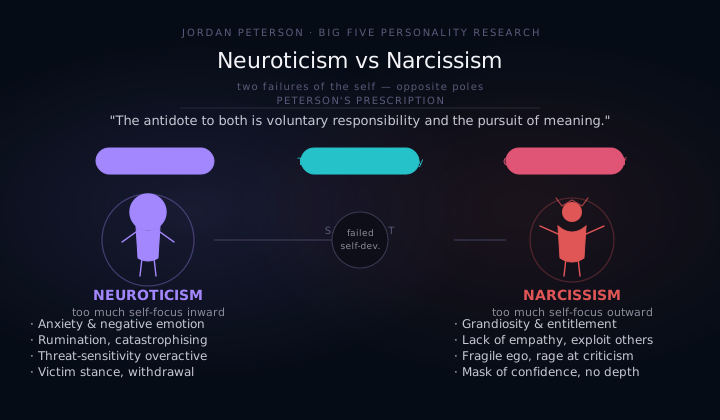
Jordan Peterson has spent the better part of thirty years sitting across from people who are suffering, and a recurring pattern emerged from those thousands of hours: the people in his consulting room tended to cluster around two poles. One group was consumed by anxiety, self-doubt, and a pervasive sense that the world was dangerous and they were inadequate to meet it. The other group was consumed by a brittle grandiosity — a performance of superiority that cracked the moment anyone pushed back. On the surface these look like opposite problems. Peterson's argument, grounded in Big Five personality research and Jungian depth psychology, is that they share a common root.
The Big Five Framework Peterson Draws From
Peterson's academic career was built around the Big Five model of personality — the five broad trait dimensions that have proven robust across cultures, languages, and decades of research: Openness, Conscientiousness, Extraversion, Agreeableness, and Neuroticism. Of these, Neuroticism is the one that Peterson returns to most often in his clinical and public work, because it is the trait most reliably associated with psychological suffering. High-Neuroticism individuals experience negative emotion more frequently and more intensely than others. Anxiety, guilt, embarrassment, irritability, depression — these are the characteristic companions of a neurotic temperament.
Narcissism is not one of the Big Five in the same way — it is better understood as a personality disorder construct, or as a cluster of traits that sits at the intersection of low Agreeableness, high Extraversion, and a specific pattern of self-regard. But Peterson treats it as one of the central psychological failure modes of the modern West, and he has written and lectured on it extensively alongside his clinical work on Neuroticism.
"The fundamental problem is not that you have too little self-esteem. It is that you have not told yourself the truth about who you are."
What Neuroticism Actually Is
Peterson is careful to distinguish Neuroticism from mere sensitivity or introversion. It is a trait that runs deep in the nervous system — people high in Neuroticism have a threat-detection system that is, in a precise biological sense, more sensitive. Their amygdala responds more strongly to negative stimuli. Their bodies generate more stress hormones in ambiguous situations. They are, neurologically, living with a slightly louder alarm.
The problem is not the sensitivity itself. The problem is what happens when the alarm is never addressed. High-Neuroticism individuals often develop what Peterson calls a "victim stance" — a mode of interpreting experience in which the self is perpetually endangered and the world perpetually hostile. This is not fabricated. It feels entirely real from the inside. But it becomes self-reinforcing: the person withdraws from challenge, avoids situations that might generate anxiety, and in doing so never develops the evidence base that would revise their estimate of themselves upward.
Rumination is the cognitive signature of high Neuroticism. The neurotic mind replays past failures, anticipates future catastrophes, and generates an unending internal monologue of threat. Peterson's clinical observation is that this rumination is rarely about actual present danger — it is the nervous system running a simulation that has become decoupled from reality.
What Narcissism Actually Is
Narcissism, in Peterson's framework, is not confidence. It looks like confidence from the outside — the expanded posture, the easy certainty, the willingness to dominate a room. But Peterson argues that it is a performance of confidence built on a foundation of unacknowledged fragility. The narcissist cannot tolerate criticism because criticism threatens to expose the gap between the grandiose self-image and the reality underneath.
This is the clinical core of what Peterson means: the narcissist has constructed a false self — an inflated persona — to defend against an underlying sense of worthlessness. The grandiosity is compensatory. When Peterson talks about narcissism in men (his clinical work skewed heavily male), he often describes it as a failure of genuine development — the person never did the hard work of building actual competence, actual character, actual relationships, and instead substituted the performance of superiority.
"Genuine self-respect is the consequence of things you have actually done. Narcissism is what happens when you want the self-respect without the things."
The narcissist's rage at criticism is particularly telling. A person with genuine self-regard can hear criticism and evaluate it on its merits — accepting what is accurate, dismissing what is not. The narcissist cannot do this because the false self cannot tolerate scrutiny. Any criticism, however minor, is experienced as an existential threat. The response — contempt, dismissal, counter-attack — is entirely disproportionate to the stimulus, and that disproportionality is the diagnostic signal.
The Shared Root: The Unfinished Self
Here is Peterson's central insight about the relationship between the two: both Neuroticism and Narcissism are, at their core, failures of self-development. The neurotic retreats from the world and never builds the self. The narcissist projects a false self onto the world and never builds the real one. The mechanisms are entirely different. The end state is similar: a person who does not know who they actually are, who cannot face the world honestly, and who suffers as a consequence.
Peterson draws on the Jungian idea of the Shadow extensively here. Carl Jung argued that every person carries within them the aspects of their character that they have refused to acknowledge — the capacities for cruelty, selfishness, weakness, and failure that every human being possesses. The shadow is not inherently destructive. It becomes destructive when it is refused. When the neurotic denies their own anger and capacity for aggression, that anger does not disappear — it becomes resentment, which is anger turned inward and backward. When the narcissist denies their own vulnerability and inadequacy, that vulnerability does not disappear — it becomes the fragile ego that explodes at the slightest challenge.
The shadow, in both cases, is running the person from behind. The neurotic is controlled by their denied aggression. The narcissist is controlled by their denied weakness. The prescription, for both, involves the same fundamental move: turn and face what you have refused to look at.
The Distinction in Emotional Life
Peterson draws a sharp distinction in how the two types relate to emotion. The neurotic person feels too much and attributes all of it to external threat. Emotions are overwhelming, difficult to modulate, and largely interpreted as signals about the world rather than about the self. The question the neurotic is always implicitly asking is: what is wrong out there?
The narcissist, by contrast, feels a narrow range of emotion intensely — primarily the emotions related to status. Pride when dominant, rage when challenged, contempt for perceived inferiors. Empathy — the capacity to experience another person's emotional state — is specifically impaired in clinical narcissism, because genuine empathy requires a stable enough self to reach toward another. The narcissist's self is not stable. It is performing. A person who is performing cannot simultaneously be attending to the inner life of someone else.
Peterson notes that the neurotic and the narcissist often end up in the same relationships with each other, not despite their differences but because of them. The narcissist's confident performance is precisely what the anxious neurotic is looking for — someone who seems to have the certainty they lack. The neurotic's willingness to absorb blame and attribute all problems to themselves is precisely what the narcissist requires — someone who will not push back against the performance. It is an unstable and usually miserable arrangement, but it is coherent as a system.
Neuroticism and Meaning
The relationship between Neuroticism and the search for meaning is one of Peterson's most original contributions to this area. His argument is not that neurotic people are simply anxious — it is that they are anxious in a particular way that is often connected to a surplus of unused potential.
People who are high in both Neuroticism and Openness to Experience — a common combination in the intellectually serious people who tend to find their way into Peterson's audience — are acutely sensitive to the gap between what they are and what they could be. That sensitivity is, in some sense, the correct reading of their situation. They are not wrong that they are not yet who they should be. The problem is that the sensitivity becomes paralyzing rather than motivating. The anxiety about failure prevents the action that would reduce it.
"Tell the truth. Or, at least, don't lie. Do not do the thing you know is wrong. Start noticing what happens when you follow these injunctions — notice how the anxiety diminishes, how the depression lifts."
Peterson's clinical finding, replicated across his patients, is that when neurotic individuals begin to act despite their anxiety — not heroically, not grandly, but in small, specific, deliberate ways — the Neuroticism itself decreases. The threat-detection system recalibrates when it receives the evidence that you are capable of meeting threat. The body learns what the mind insists it cannot believe.
The Particular Danger of Narcissism in the Modern West
Peterson believes narcissism has become a cultural problem of particular severity in contemporary Western societies, and he traces part of this to what he sees as the corruption of self-esteem education. Beginning in the 1980s and accelerating through the 1990s, Western educational philosophy adopted the view that the route to psychological health was unconditional positive regard and the encouragement of self-esteem independent of achievement. Peterson's argument — and the empirical literature substantially backs him here — is that this produced, in many cases, exactly the opposite of what was intended.
Self-esteem that is not grounded in actual achievement and actual virtue is not self-esteem at all. It is a story told to a child that prevents them from doing the hard work that would generate genuine self-regard. The child who is told they are special regardless of what they do does not learn that they are special. They learn that the adults around them are not trustworthy, because the praise is not connected to reality. And they learn to fear challenge, because challenge might reveal the gap between the story and the truth.
This is the manufacturing process for narcissism, in Peterson's account. Not that it is the only route — there are developmental pathways involving early trauma, abusive or neglectful parenting, and constitutional factors. But the cultural amplification of unconditional praise without responsibility is, for Peterson, a reliable way to produce adults who need the world to confirm their specialness and cannot tolerate the evidence that it will not.
What Actually Resolves Both
The prescription Peterson offers is not symmetrical — you do not treat Neuroticism and Narcissism by simply moving toward the centre on some scale. But they share a common requirement, and it is this: the willingness to take up genuine responsibility, in reality, and to let that responsibility be the measure of who you are.
For the neurotic, this means acting despite anxiety. It means choosing a goal that is actually meaningful — not safe, not guaranteed, but genuinely important — and pursuing it with enough honesty to notice when you are making progress and when you are not. Peterson's clinical observation is that purpose is specifically therapeutic for Neuroticism, because purpose gives the threat-sensitive nervous system something useful to do. Fear that is directed toward a goal becomes courage. Fear that is directed nowhere becomes anxiety.
For the narcissist, the requirement is more confrontational: the false self must be allowed to fail. This does not happen voluntarily. Narcissists rarely seek therapy until the performance collapses — a relationship ending, a career failure, a crisis that the grandiose self-image could not absorb. The therapeutic work is to begin building a real self on the rubble of the false one. This requires something the narcissist has been specifically avoiding: honesty about limitation, genuine comparison of self against a standard rather than against other people, and the slow, unglamorous work of actually developing the competencies they have been pretending to possess.
"Compare yourself to who you were yesterday, not to who someone else is today."
The Shadow and the Monster on a Leash
Peterson's most vivid contribution to this area is his reformulation of the Shadow. He is explicit that the goal is not to eliminate the dark elements of the personality — the aggression, the selfishness, the capacity for cruelty. The goal is to become aware of them, to take responsibility for them, and to direct them consciously. This is what he means by the "monster on a leash": not a domesticated self, but a dangerous self that is under conscious command.
For the neurotic, this means acknowledging the anger and aggression that has been converted into resentment. Peterson is direct about this in his clinical work: neurotic individuals who are consumed by victimhood are often harbouring enormous anger that they cannot permit themselves to feel directly. The therapeutic work involves contacting that anger, understanding its legitimate basis, and then deciding what to do with it — which is different from either expressing it destructively or suppressing it endlessly.
For the narcissist, it means acknowledging the weakness and inadequacy that the grandiose performance is covering. This is the harder assignment, because the narcissist has more invested in the performance. But Peterson argues that genuine strength — the kind that does not need to announce itself, that can hear criticism without shattering, that can pursue a goal without needing continuous external validation — is only possible once the underlying fragility has been faced and accepted.
A harmless man, Peterson quotes approvingly, is not a good man. He is merely a weak one. Genuine goodness requires the capacity for harm, held under voluntary restraint. This is as true of the neurotic who must develop their aggression as of the narcissist who must develop their genuine empathy. Both require the same movement: toward a self that is real, acknowledged, and chosen — rather than a self that is performed, denied, or defended.
The Clinical Insight That Changes Everything
The observation that Peterson returns to most often, and that he regards as the most clinically consequential, is this: both the neurotic and the narcissist are lying to themselves, and the lying is the primary mechanism of their suffering. The neurotic lies about their capacity — telling themselves they cannot do what they can. The narcissist lies about their nature — telling themselves and others that they are what they are not.
The antidote is the same in both cases: precise speech, which is what Peterson means when he says tell the truth. Not the rhetorical truth of motivated self-presentation, not the comfortable truth of social performance, but the precise and often uncomfortable truth of what is actually the case — about who you are, what you want, what you have done, and what you have failed to do.
The clinical finding that organises everything else in Peterson's work is that people who begin to speak more precisely about their own lives — including and especially the parts they find shameful — begin to suffer less. The anxiety decreases. The grandiosity deflates. The actual self, having been acknowledged, turns out to be both more limited and more capable than the performed self in either direction. It is, most importantly, real. And reality, however modest, is something a person can actually stand on.