Maps of Meaning: The Book Peterson Wrote First, and What It Actually Argues
Jordan Peterson worked on Maps of Meaning for thirteen years before he was a public figure. It is dense, technical, and largely unread by his audience — yet every framework he has used in public since is a sentence-sized version of an argument the book makes at length. What is actually in it: chaos and order, the explored and the unknown, the dragon and the gold, the voluntary descent that brings the hero back.
Maps of Meaning is the book Jordan Peterson worked on for thirteen years before he was a public figure. It is dense, technical, and largely unread by his audience — an academic work published in 1999 that makes its way through mythology, neuroscience, clinical psychology, and biblical exegesis with the pace of someone who knows he has a lot to say and is willing to take the time. But every framework he has used in public since — chaos and order, the hero, voluntary sacrifice, the dragon, the line through the human heart — is a sentence-sized version of an argument he laid out at book length in 1999. The essay that follows walks through what is actually in it.
The question that started it
Peterson has told the origin story repeatedly. In his twenties, in the late Cold War, he could not stop thinking about the question of how ordinary people had carried out the atrocities of the twentieth century — the Gulag, the Nazi camps, the Maoist famines. The question haunted him: were the people who did these things fundamentally different from him, from anyone? Or was there something structural in the human psyche that could be twisted toward mass cruelty? The book is his attempt at an answer. His core conviction by the end of writing it: the people who did those things were not aliens. They were human beings whose maps of meaning had been distorted in a specific, structural way, and the same distortions are available to anyone. The atrocities were not aberrations but possibilities latent in every psyche, waiting to be activated under the right conditions of ideological rigidity and moral collapse.
The three regions of the map
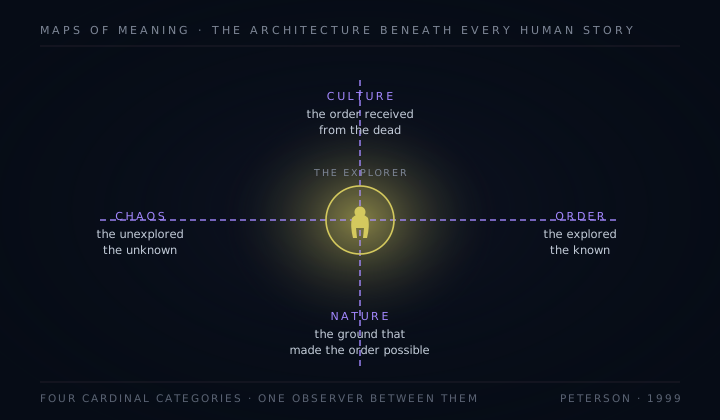
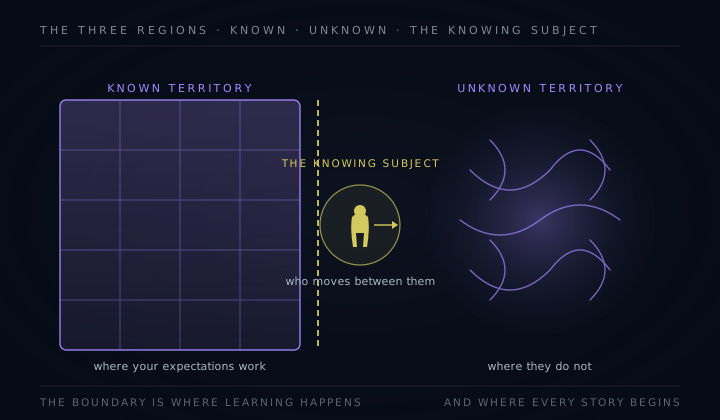
The book's architecture, in plain language, is tripartite. Peterson argues that every human being navigates the world using a map made of three fundamental territories: known territory (the place where your expectations work — your routines, your competences, your home); unknown territory (the place where they don't — the new job, the dying parent, the stranger, the symptom that has no name); and the knowing subject (the part of you that moves between them). The map is not a model the conscious mind invented; it is the ancient categorical structure underneath every story humans tell. Order, chaos, and the explorer who mediates between them. Peterson's claim is that this tripartite structure is not arbitrary or culturally specific but neurologically and psychologically fundamental — that the brain itself organises experience this way, and that mythologies across unrelated cultures encode the same structure because they are all describing the same underlying reality of human navigation through a world that is part stable, part unstable, and always requiring mediation.
What myth actually is
The claim that gets Peterson into the most trouble with materialists, but which is the engine of the book. Myth, in his reading, is not bad science or pre-scientific cosmology. It is the encoded record of how to live in a world made of order, chaos, and the unknown. The Mesopotamian myth of Marduk slaying Tiamat is not a story about how the world was physically made; it is a story about how a sovereign individual — Marduk, speaking the truth, facing the chaos directly — establishes order. The Christian narrative, the Egyptian narrative of Horus and Seth, the Babylonian narrative: all encode variants of the same structural lesson, because the human psyche keeps re-deriving it. Peterson's argument is that myths are not false; they are true in a way that precedes and enables empirical truth. They map the moral and psychological terrain that scientific description presupposes but cannot replace. The myth tells you what to do; the science tells you what is. Both are necessary, and the myth comes first.
The dragon
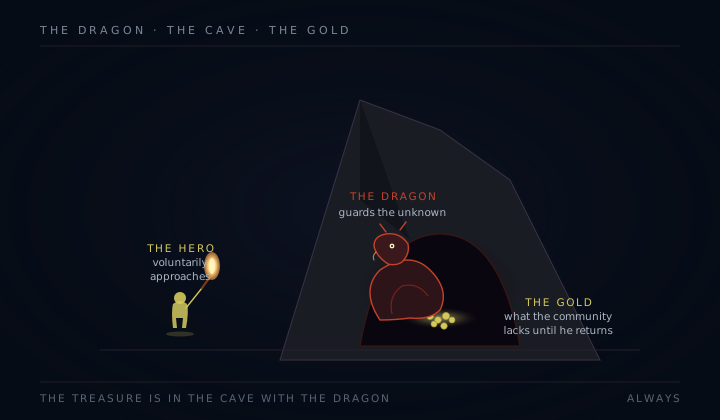
The image Peterson uses most. The dragon — guarding the cave, the gold, the virgin — is the symbol of the unknown that bites. He is careful: the dragon is not a metaphor for fear; the dragon is the predator at the edge of your explored territory. The treasure is in the cave with the dragon because the unexamined territory is also the territory where everything you do not yet know how to do is waiting to be learned. Avoiding the dragon means staying small. Confronting the dragon, voluntarily, is what the hero does. The hero brings back gold. Peterson frames this in neurological terms as well: the brain's threat-detection systems are ancient, and they encode predators as dragons — serpentine, lurking, dangerous. The mythological dragon is not invented; it is the form that existential threat has always taken in human imagination, because that is how the brain represents what could destroy you if you venture beyond the familiar.
The hero, voluntary
The hero, in Peterson's reading, is not the strong man. The hero is the person who voluntarily goes into the unknown for the sake of the group. Voluntary is the operative word. The descent matters because it is chosen; the suffering matters because it is borne for a reason. This is why heroic narratives across unrelated cultures end the same way: the hero confronts the unknown, is partially or wholly destroyed by it, and brings back something — a treasure, a teaching, a body, his own renewed self — that the community lacked before. The voluntary descent is, in Peterson's reading, the structural opposite of resentment. Resentment is the refusal to engage with the unknown, the insistence that the world is fundamentally unjust and that suffering is meaningless. The hero's stance is the opposite: suffering is inevitable, but it can be made meaningful through voluntary engagement with the source of the suffering. The hero does not wait to be dragged into chaos; he walks into it with his eyes open.
What goes wrong — the totalitarian map
The diagnosis. People whose maps of meaning have failed have two failure modes available to them. The first is despair: the map is wrong and they collapse. The second, more dangerous, is rigidification: the map is wrong but they double down on it, refuse to encounter the chaos, refuse to update, and eventually attack the parts of reality that contradict the map. This second mode, Peterson argues, is the psychological structure of the totalitarian. The twentieth-century atrocities he started the book wanting to explain happened, in his reading, because millions of people refused the necessary descent and externalised the chaos into a category of people to destroy. The Jew, the kulak, the class enemy — these became the repositories of everything that threatened the rigid ideological map. The totalitarian does not confront the dragon; he projects the dragon onto a scapegoat and kills the scapegoat, over and over, in the vain hope that order will be restored. It never is, because the problem was never the scapegoat. The problem was the refusal to update the map.
What goes right — the explorer's stance
The book's positive prescription. The healthy psyche is not the one with the correct map; it is the one that knows the map is always partly wrong, and that updating the map — voluntarily, by going into the unknown when the signal arises — is the work. The figure of the explorer, in Peterson's reading, is the ancient model for what a person should be. Not the warrior; the explorer. Peterson frames this in terms of attention: to pay attention is to sacrifice the parts of the world you are not attending to, and to elevate the object of attention to the status of something worth investigating. The explorer is the one who attends to the anomaly, the thing that doesn't fit, the signal that the map is incomplete. The explorer does not ignore the dragon; he investigates it. And in investigating it, he expands the territory of the known and brings back resources the community did not have before.
Why this is under everything else he says
The reader-facing point. Once you have read the book, the rest of Peterson's public output stops looking like a sequence of separate arguments. Tell the truth (Maps: the logos is what stabilises the world against chaos). Clean up your room (Maps: voluntary attention to your own corner of explored territory). Pick up the heaviest weight you can bear and carry it (Maps: voluntary descent is the hero's move). The Solzhenitsyn material, the lectures on the Bible, the political commentary, the addresses to young men — these are all sentence-sized restatements of arguments the book makes at book length. Once you see the architecture, the same building keeps appearing. The framework is remarkably consistent: there is order, there is chaos, there is the individual who mediates between them, and the mode of mediation is voluntary engagement with the unknown, predicated on the willingness to update your map when reality contradicts it. The political follows from the psychological; the ethical follows from the structural. It is all one argument, elaborated across different domains.
Maps of Meaning is, by Peterson's own admission, not a book most people will read. The argument is dense; the citations are heavy; it took him thirteen years for a reason. But the structure it lays out is older than the book — Peterson would say it is older than language — and it is, on his telling, what every meaningful human story has been about. Whatever the reader makes of him, the architecture is what he built.