Facing Depression: Peterson on the Clinical Picture and His Own Crisis
Jordan Peterson has talked about depression as a clinical psychologist with decades of practice and as a person who has survived a severe personal crisis of his own. What he actually thinks the illness is, the biological prescription he gives almost every patient, what he learned from being on the other side of the consulting-room door, and the careful language he uses with people who are in it now.
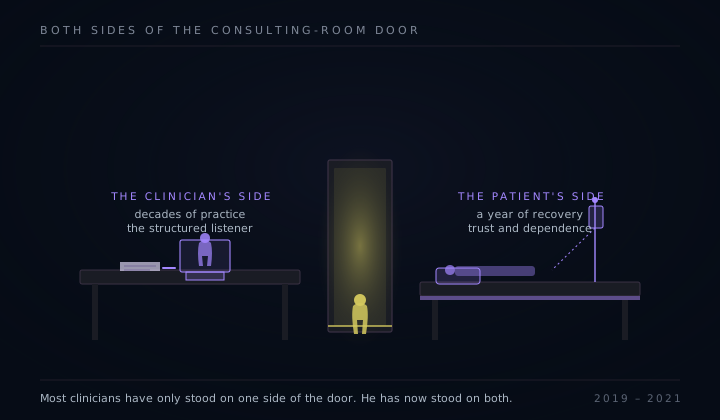
Jordan Peterson holds an unusual authority when he speaks about depression. He is a clinical psychologist who spent decades treating patients with depressive illness. He is also someone who has lived through a severe depressive episode himself, and then, years later, survived a medical crisis so serious that it nearly killed him — a cascade that began with a benzodiazepine prescribed for acute distress and ended with a year-long recovery from akathisia and dependency. His wife Tammy received a terminal cancer diagnosis during the same period. Depression runs in his family; he has watched it move through generations. When he discusses the illness now, he does so from both sides of the consulting-room door. What follows is a synthesis of how Peterson frames depression clinically, what he recommends to people in it, and what he learned when he became the patient. This is editorial reporting, not medical advice. A serious depressive episode warrants a serious clinical conversation with a qualified professional.
What he actually thinks depression is
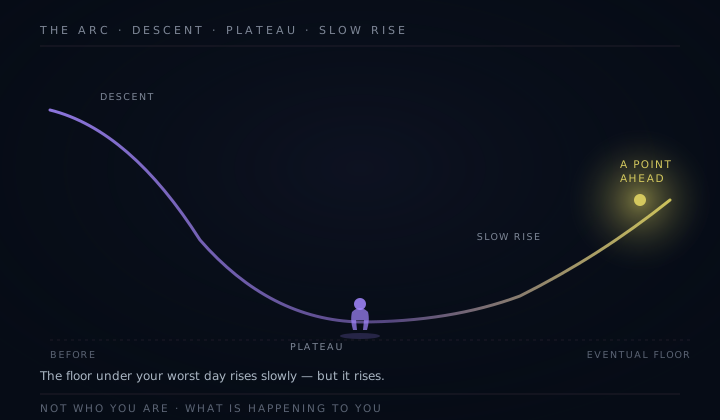
Peterson's clinical view of depression is straightforward and biological. Depression is a real illness with a strong heritable component — not a moral failure, not a personality flaw, not something a person can resolve by deciding to feel better. He emphasises repeatedly that heritability matters: people whose parents faced depression carry a significantly elevated risk themselves. This is not an abstract statistical point for Peterson; it is a clinical fact with immediate therapeutic consequences. People in depression, he observes, routinely interpret the symptoms — the profound lack of motivation, the absence of pleasure, the flattening of energy — as evidence that they are fundamentally bad, weak, or defective. That interpretation becomes an accelerant; it makes the illness worse. The first therapeutic move, in his telling, is to separate the illness from the person. Depression is not who you are. It is something happening to you, something with neurochemical and genetic substrates as real as any other medical condition. The framing matters because shame is toxic to recovery, and the illness itself generates shame by design.
The biological floor
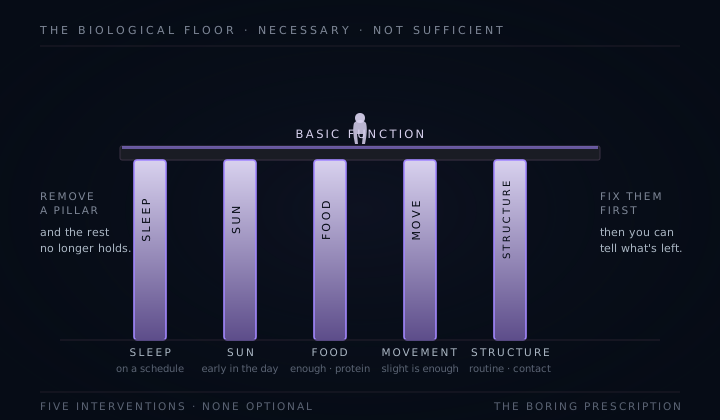
Peterson has what he calls a "boring" prescription — the set of interventions he discusses with almost every depressed patient before anything else. Sleep on a regular schedule, at consistent times. Eat enough, with deliberate attention to protein early in the day. Get outside into real daylight during morning hours. Move the body in some structured way, even minimally. Resist the gravitational pull toward isolation. He frames these not as cures but as the biological floor: necessary, not sufficient. No amount of psychological insight or therapeutic conversation can compensate for a body whose circadian rhythm is chaotic, whose blood sugar is unstable, whose musculature is inert, and whose social contact has collapsed to zero. The point is not that exercise cures depression — it does not — but that you cannot assess what treatment you actually need until the floor is stable. Depression destabilises everything; the body's regulatory systems fail in tandem. Peterson's clinical stance is that you begin by re-establishing the minimum conditions under which a nervous system can function, and only then do you attempt to address what lies above that floor.
Meaning is not a luxury
Here Peterson diverges from much of standard clinical practice. He argues that a meaningful aim — something worth pursuing, something that matters to the person — is not optional or ornamental. It is medically important. He grounds this claim in the neuroscience of positive affect: when people pursue a goal they regard as significant, the act of moving toward it activates dopaminergic pathways that resemble the neurochemical signature of healthy mood. Depression suppresses precisely that system. A person without an aim is not merely adrift in an existential sense; they are missing one of the physiological mechanisms by which mood regulates itself. The clinical implication is practical. Helping a depressed patient identify even one small thing they would feel ashamed not to do, and then helping them take the smallest possible step toward it, constitutes real treatment. This is not about grand ambitions or life-changing projects. It is about the orientation of the person toward something outside themselves that makes a demand. The demand itself, Peterson suggests, reactivates the system that depression has switched off. The pursuit of meaning is a biological intervention.
The thing about responsibility
Peterson's emphasis on responsibility is distinctive and counterintuitive. He argues that voluntarily accepting a meaningful burden — caring for something, taking ownership of a piece of one's own life, shouldering a responsibility one did not choose — does something for the depressed person that passive rest does not. People in depression often feel they cannot carry more weight; the illness makes even trivial tasks feel unbearable. Peterson's clinical observation is that being asked to carry something meaningful is sometimes what allows a person to stand upright. He is careful to distinguish this from the "pull yourself up by your bootstraps" dismissal of suffering. This is not about willpower overriding biology. This is about the neurological system that activates when you decide what you are for — the same system depression disables. The act of accepting responsibility, in his framework, is not an additional burden on top of the illness. It is a switch that begins to turn the illness off. The clinical task is to help the patient find the lightest meaningful load, not to remove all weight.
His family — what he knew was coming
Peterson has spoken openly about depression in his own family. His father lived with it. He watched the illness move through his relatives across generations, observing its patterns with the dual awareness of a clinician and a son. By his late thirties, he knew he carried a high genetic risk himself. That knowledge did not protect him when his own episode arrived, but it gave him a framework for understanding what was happening. He discusses this not as confession but as transmission: this is what genetic loading looks like from inside the family that carries it. It is one thing to know the statistics of heritability in the abstract; it is another to watch your own father struggle and to recognise that the same neurochemical vulnerabilities are written into your own biology. Peterson's willingness to name this publicly is part of his broader insistence that depression is not a private shame to be hidden but a medical reality to be acknowledged and addressed.
His own depression — and the dietary experiment
Around 2015 and 2016, Peterson developed a severe depressive episode. Conventional pharmacological treatments produced limited relief. During this period, both he and his daughter Mikhaila — who was dealing with severe autoimmune disease — began experimenting with increasingly restrictive diets, eventually converging on an all-meat elimination protocol. Peterson has described the outcome candidly: the diet appeared to clear inflammatory symptoms and produced significant mood improvement. He is equally candid about the limits of the evidence. This is a clinical anecdote involving two people, not a randomised controlled trial. The mechanisms remain speculative; the generalisation to other patients is uncertain. But the subjective relief, for him and for his daughter, was real and substantial. From that point forward, his clinical conversations included a greater openness to the possibility that mood disturbances could have inflammatory or autoimmune substrates that standard psychiatric treatment might not address. It reshaped his sense of what treatment could mean.
The benzodiazepine crisis
The most public chapter of Peterson's medical story began in 2019, when his wife Tammy received a diagnosis of terminal cancer. Peterson was prescribed clonazepam, a benzodiazepine, to manage acute anxiety in the face of that catastrophe. The drug was appropriate for the context — a real psychiatric emergency. But Peterson developed physical dependency. When he attempted to reduce the dose, he entered a state of severe akathisia, an inner agitation and restlessness so unbearable that patients describe it as worse than the original condition. Standard withdrawal protocols failed. After seeking treatment in multiple countries, he was ultimately treated in Russia under an induced-coma protocol, a high-risk intervention that nearly killed him. He spent more than a year in serious medical recovery, relearning basic motor and cognitive functions. He has spoken about this crisis with notable openness, and what he emphasises is precise: the medication, prescribed appropriately for a legitimate condition, became a more severe problem than the anxiety it was meant to treat. The dependency and the akathisia were not a failure of will or discipline. They were an iatrogenic medical disaster.
What he learned from being the patient
Peterson's clinical voice changed after the benzodiazepine crisis. He speaks now with greater emphasis on the difficulty of being the patient — the vulnerability required to trust a prescription, the thinness of the line between a medication that helps and one that takes over your life. He discusses psychiatric drugs more carefully than he did before, not in opposition to them but with humility about what they do over long time horizons and what can go wrong even when everything is done correctly. He stresses the importance of the people around the patient, because the patient often cannot advocate for himself. In his case, his daughter Mikhaila played a critical role in navigating the medical system when he was incapable of doing so. He acknowledges that he was extraordinarily fortunate: he had family, financial resources, and a public platform. Most people in similar crises do not. The implication for clinicians is sobering. The prescription, the diagnosis, the formal intervention — these are the smaller half of the treatment. The remainder is the surrounding structure of care, the people who remain present when the patient cannot remain present to himself.
What he tells people who are in it now
Peterson's advice to people currently in a depressive episode has been consistent across hundreds of recorded talks and clinical discussions. Stabilise the biological floor first: sleep, sunlight, food, movement. Do not attempt to repair your life while your body's regulatory systems are in collapse. Get a real clinical evaluation from a qualified professional; do not diagnose yourself, and do not treat yourself. Tell at least one person in your life what is actually happening. Do not carry this alone. Isolation is one of the symptoms, and it is also one of the mechanisms by which the illness sustains itself. Find one small thing you would feel ashamed not to do tomorrow, and do it, even badly. The pursuit itself matters more than the outcome. Accept that recovery is not linear. There will be terrible days after good days. The measure of progress is not that the bad days disappear; it is that the floor under your worst day slowly rises. Do not romanticise the illness, but do not be ashamed of it either. It is an illness. Illnesses can be treated. As Peterson puts it,
Depression is not who you are; it is something that is happening to you.That distinction is clinical, not rhetorical, and it is the first piece of ground on which the rest of the work has to stand.
The clinician who became a patient, and then a clinician again, says the same thing from both sides of the door: this is real, this is treatable, and you are not the worst version of yourself. You are a person who is sick. That distinction — between the illness and the person inside it — is, in Peterson's framework, the first move in treatment and the condition for everything that follows.