Five Minds Behind the Lectures: Peterson on Piaget, Rogers, Friston, Eliade, and Griffiths
Most of Jordan Peterson's personality framework can be traced through five thinkers he returns to lecture after lecture. The developing child (Piaget), the conditions for change (Rogers), the predictive brain underneath (Friston), the religious depth (Eliade), and the chemical frontier that briefly opens it (Griffiths). Walk through each in his voice.
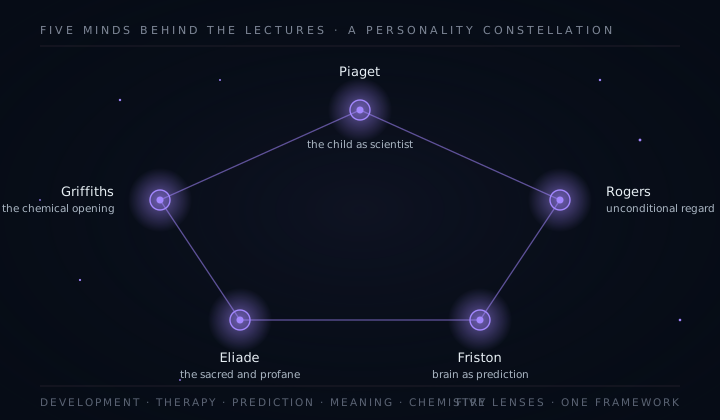
Most of Jordan Peterson's personality framework can be traced through five thinkers he returns to, lecture after lecture, sometimes naming them explicitly, sometimes weaving their ideas into the argument without attribution. They are arranged, almost by accident, in roughly the order a person grows up through them: the developing child, the conditions for change, the predictive brain underneath, the religious depth the person eventually meets, and the chemical frontier that briefly opens that depth wide. The five are Jean Piaget, Carl Rogers, Karl Friston, Mircea Eliade, and Roland Griffiths. Each gives Peterson a piece of the architecture — developmental, therapeutic, computational, mythological, pharmacological. This essay walks through each in turn, in Peterson's voice, and explains what he takes from them.
Piaget — the child as scientist
Jean Piaget was a Swiss developmental psychologist, but Peterson reads him as something closer to a moral philosopher who happened to use children as his laboratory. Piaget proposed that the child is not a blank slate waiting to be written on by culture, but an active builder of mental models — a scientist in miniature, constructing and testing theories about how the world works. The child moves through four developmental stages: sensorimotor (birth to two), preoperational (two to seven), concrete operational (seven to eleven), and formal operational (eleven onward). Each stage is scaffolding the mind grows around, not a curriculum imposed from without. But Peterson's particular fascination with Piaget centres on something narrower and stranger: Piaget's observation that children construct moral rules through play. Ethics, on this view, does not descend from heaven or from parental authority. It emerges out of repeated games whose rules the children themselves negotiate, refine, and treat as sacred. Peterson cites this as evidence that moral structure is not imposed from above but discovered from below, built collaboratively in the microcosm of the playground. This is why play matters more than people think. It is the laboratory of reciprocity. Peterson draws a sharp distinction here between Piaget and Freud. For Freud, the regulation of aggression and sexuality is a consequence of compulsion — the superego saying no. But the Piagetian view, Peterson insists, is that "those impulses are not inhibited, they are integrated into a higher mode of being." The child does not suppress the desire to cheat; the child comes to see why fairness is worth maintaining. That integration, not repression, is the developmental achievement Piaget mapped.
Rogers — the conditions for change
Carl Rogers was an American humanistic psychologist who pioneered client-centered therapy, and Peterson treats him as the secularised inheritor of the Christian doctrine of redemption. Rogers had been training to be a missionary before he lost his faith; the therapeutic stance he later developed — unconditional positive regard, accurate empathy, genuine listening — is, in Peterson's reading, "a recasting of the Christian idea of redemption into the realm of secular mental health." The core Rogerian claim is that people do not change inside a hostile field. The therapist's job is not to argue someone out of their position, not to diagnose and correct, but to listen so closely that the patient can hear themselves think — and then to reflect back what they actually said. Peterson returns to this point repeatedly: the precondition for transformation is being heard. Rogers believed that truth-seeking in the therapeutic process was intrinsically redemptive, "a restatement of the gospel notion that the truth will set you free," as Peterson puts it. The technique is simple but difficult: listen, and summarise to the other person's satisfaction. Do not interrupt with your own interpretation. Do not begin formulating your reply while they are still speaking. The experiment, Peterson notes, is that if you genuinely listen to someone who disagrees with you, they will tell you things that reveal your errors and make you change — "and that might be a good thing if you know that you're so damn ignorant that a little humility's in order." Peterson is not uncritical of Rogers. He thinks "unconditional" overstates the case, and that meaningful change also requires confrontation. But he keeps coming back to the same mechanism: voluntary transformation begins when someone else takes you seriously enough to hear what you are actually saying.
Friston — the brain as prediction machine
Karl Friston is a British computational neuroscientist, and his free-energy principle gives Peterson the mathematical language for what he had previously framed mythologically. Friston's central claim is that the brain is not, fundamentally, a thing that receives sensory data and interprets it. It is a thing that constantly predicts what it expects to perceive next, and processes only the prediction errors — the mismatches between expectation and reality. Personality, on this view, is a particular set of long-running predictions about self, world, and other people, predictions that the body's anxiety system enforces. Peterson connects this directly to his own framing: anxiety is what fires when the world does not match the map. Meaning is what fires when the map and the world align in a way that matters. Friston's framework allows Peterson to say something precise about why people cling so desperately to their beliefs. If you understand that aim constrains entropy — that having a goal reduces the number of open pathways and therefore the cognitive load — then you get some sense why the collapse of a framework feels like the collapse of the world. High entropy is physiologically expensive. It burns future resources in the present; it ages you. Conversely, positive emotion, Peterson notes, is also an entropy-reduction phenomenon. When you take a step toward your goal and succeed, you get a dopaminergic kick, because the probability of success has increased and the uncertainty has decreased. Both anxiety and hope are responses to entropy. Friston gives Peterson the tools to describe what religious language had always described less precisely: that meaning is not a subjective overlay but a real signal, a measure of fit between the organism and the structure it navigates.
Eliade — the sacred and the profane
Mircea Eliade was a Romanian historian of religion, and Peterson uses him to argue that the religious instinct is structural, not contingent. Eliade's central claim was that for most of human history, people did not experience the world as flat. There was sacred space — the temple, the centre, the axis mundi — and there was profane space, everywhere else. The boundary between them was structurally meaningful. The sacred was where heaven and earth touched, where meaning was most concentrated, where orientation was possible. Peterson draws on Eliade to argue that modern people, having flattened the map, have not eliminated the categories. They have only displaced them. The longing for the sacred reasserts itself wherever it can find purchase: in politics, in fandom, in identity, in the pursuit of peak experience. Peterson frequently returns to the image of Jacob's ladder or the shamanic tree at the centre of the cosmos — "that which is at the peak of that, that recedes as you approach it and that calls you continually to what's better and better." That vanishing point, the destination that remains infinitely distant no matter how far you climb, is what Eliade helps Peterson name. It is the phenomenon of ultimate value, the good as such. Eliade gives Peterson the historical vocabulary for the claim that this phenomenon is not invented by cultures but discovered by them, over and over, in different forms. The sacred is the place where the highest value shines through. The profane is everything else. And the modern crisis, in Peterson's reading, is not that we have transcended this structure but that we have lost the language to recognise it.
Griffiths — the chemical opening
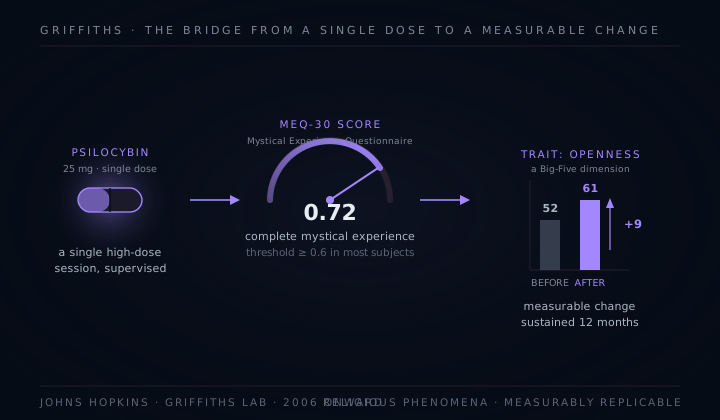
Roland Griffiths was an American psychiatrist at Johns Hopkins who led the modern resurgence of psilocybin research, and Peterson treats his work as a kind of empirical bridge between the religious phenomena Eliade described and the neuroscience Friston models. The studies Peterson keeps citing are these: high-dose psilocybin, administered under controlled conditions, reliably produces what subjects rate as among the most meaningful experiences of their lives — experiences often indistinguishable from spontaneous mystical experience as classically described in the religious literature. Personality measurably changes. The trait of openness rises, and it rises in a way that personality psychology had previously considered impossible after early adulthood. Psilocybin also shows promise in the treatment of depression, anxiety, end-of-life distress, and addiction. Peterson is careful here. He does not romanticise the substances; he is aware that things can go badly wrong. But he treats the Griffiths data as evidence that "the religious" is not a cultural artefact. It is something the brain can be made to do under the right conditions, something that leaves measurable traces, something that changes people in ways they themselves describe as redemptive. The psychedelic state, Peterson notes, produces a physiochemical condition analogous to high stress — a state of neuroplasticity that disinhibits the effects of memory on perception. Most of what you see, most of the time, is what you presume. The psychedelic reverses that, allowing the world to become magical again, as it was in childhood. This is dangerous. It can degenerate into hell. But it also facilitates learning, facilitates transformation. Griffiths gives Peterson the empirical warrant to take seriously the claim that there are states of consciousness in which the structure of meaning becomes visible, and that those states are real.
Why these five, together
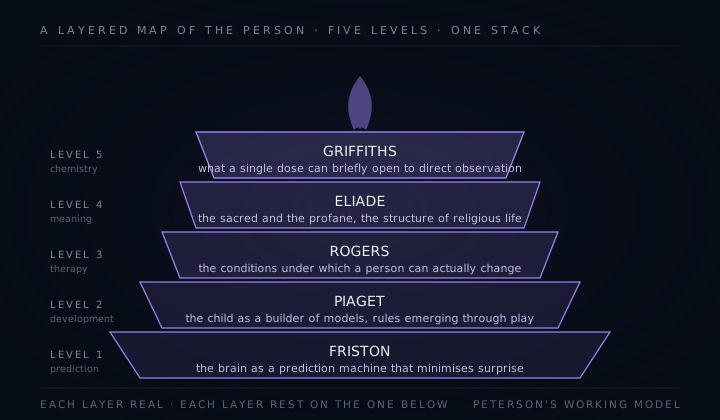
The synthesis Peterson is reaching for, even when he does not name it explicitly, runs something like this. Piaget shows how the mind builds itself — actively, collaboratively, through play and negotiation. Rogers shows the conditions under which that mind can rebuild itself in adulthood — through being genuinely heard, through the courage to articulate what one actually thinks. Friston gives the underlying mechanism: predictive systems that minimise surprise, that resist entropy, that enforce coherence at a metabolic cost. Eliade names the structure of what those predictive systems point toward at their deepest — the axis mundi, the centre, the place where meaning is most concentrated. And Griffiths shows that the structure Eliade described is not merely metaphorical; it can be intervened on chemically, opened wide, made temporarily and overwhelmingly present. Peterson uses these five, layered, to argue against the flat-materialist picture of human beings without retreating from biology. The architecture of the mind is real; so is the architecture of meaning above it. Both can be studied. Both matter. The mistake is to collapse one into the other — to say that because meaning is neurologically instantiated, it is therefore illusory, or to say that because meaning feels transcendent, neuroscience is irrelevant. Peterson's wager is that you can hold both.
None of these five thinkers are Peterson's invention. He is reading them as a clinician who needed each of them to make sense of what was sitting in his consulting room. The result is not a single theory but a layered map — biology, development, therapy, religion, chemistry — held together by the conviction that personality is a real thing, that meaning is a real thing, and that the two are more closely connected than either side of the standard arguments admits.