Stand Up Straight: Peterson on Posture, Body Language, and the Hierarchy Your Body Broadcasts
The way you hold your body is not just a physical habit — it is a live broadcast of where you believe you stand in the world. Peterson's Rule 1 is built on a surprising piece of neuroscience: the same serotonin system that governs social rank in lobsters runs in you, and it reads your posture. Stand upright and the system tilts toward confidence. Slouch and it tilts toward defeat. Your body is always signalling — to others, and to yourself.
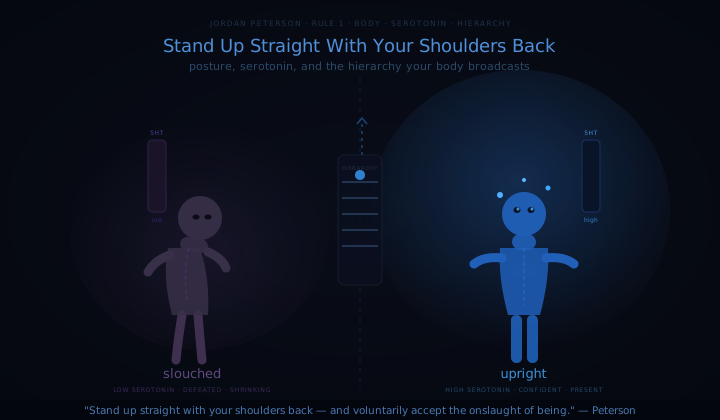
Peterson's first rule in 12 Rules for Life is deceptively simple: stand up straight with your shoulders back. It reads like advice from a Victorian schoolmaster. But the argument behind it is rooted in evolutionary neuroscience, and it goes far deeper than good posture for its own sake.
The serotonin system is older than you think
The first thing Peterson explains is that the system governing your social behaviour and emotional state is ancient — far older than the human species. "The serotonin system is the system that tracks hierarchical information and it's so crucial that it actually sets up your brain in utero. It's the master control system of the brain. If you thought about the brain as a symphony — which is actually a pretty good way of thinking about it from a metaphorical perspective — the serotonin system would definitely be the conductor."
This system exists in lobsters. It exists in every vertebrate and in many invertebrates. When a lobster loses a fight, its serotonin drops, its posture changes — it physically shrinks, holds itself lower, signals defeat in its very shape. When a lobster wins, serotonin rises, posture expands, and the animal moves through the world differently. Other lobsters read this instantly and adjust how they treat it accordingly.
You have the same system, running the same logic. It was not built for the modern world. It does not know you are in an office or a job interview or a difficult conversation. It reads the signals it was built to read — posture, movement, the way you hold your body in space — and adjusts your neurochemistry accordingly.
What your posture is broadcasting
"The first rule is stand up straight with your shoulders back," Peterson says, "and it's really a description of the ancient nature of hierarchies — their almost universal existence among living creatures — and the fact that you have extraordinarily ancient and profound neurological systems that really govern your psyche, that process hierarchical information."
When you stand upright, shoulders back, chin level, you occupy your full physical space. Your serotonin system reads this as a signal of high hierarchical position. It adjusts: it dampens down anxiety, stabilises emotion, raises the threshold for negative reactivity. You feel more competent than you did thirty seconds ago — not because anything external changed, but because the ancient system that governs your emotional state got a different input.
When you slouch — shoulders forward, chest contracted, head down — the system reads defeat. "If you get tossed down the hierarchy — let's say you get fired — it wreaks havoc with your serotonergic function. It makes you defeated, like the defeated lobsters I wrote about, and then all of a sudden you're way more susceptible to negative emotion."
The body and the hierarchy are not separate things. The body IS the hierarchy signal. And that signal runs in both directions — from the world into you, and from you into the world.
Others read your body before they hear your words
Non-verbal communication is not a supplement to what you say. In most social contexts it is primary. Peterson points to how animals communicate: they read posture, movement, breathing, position — all of it is happening before any words. Humans do exactly the same, mostly without knowing it.
The way you enter a room, sit at a table, stand in front of a group, hold your hands when speaking — all of this is broadcasting hierarchical information to everyone around you. And people respond to it. Consistently. Someone who carries themselves with uprightness and ease is treated differently than someone who carries themselves with contraction and apology. Not because people consciously decide to treat them differently — because the ancient hierarchical reading system in every observer responds automatically.
This creates the feedback loop Peterson emphasises: stand upright → others treat you with more respect → your serotonin reflects this → you feel more competent → you stand more upright. The loop can also run in reverse, compounding defeat in the same way it can compound confidence.
Standing up straight is a voluntary act
What makes Peterson's framing unusual is the moral weight he places on posture — not as vanity but as courage. "To stand up straight with your shoulders back — that you could actually voluntarily accept the onslaught of the tragedy of being, and that you can constrain the proclivity for malevolence that's part of you and part of the world — and that in that you can discover your own value, your own intrinsic value."
Slouching is a physical form of shrinking from the world. Uprightness is a physical form of engaging with it — of saying, in the language your nervous system understands: I am here, I will face this. The choice to stand upright is, in Peterson's reading, a form of voluntary courage. You are not pretending nothing is difficult. You are choosing to face it anyway, and your body is the first place that choice is made.
Movement, volume, and presence
Posture extends into movement. How you walk — whether you move with directness or hesitancy, whether you take a clear path or defer constantly to others' movement, whether your pace signals purpose or apology — communicates the same hierarchical information.
Peterson notes that even voice is part of this: "You can tell them — stand up a little more, put your shoulders back a little more, a little more volume so I can hear you. It can be a little game — God, they learn that so fast you can hardly believe it. And I don't know why they're not taught that, I think because people are afraid of competence — and so they're afraid to teach kids to be competent."
Volume is not aggression. Speaking clearly and audibly at a sufficient level is the vocal equivalent of standing upright. It signals that you believe your words are worth hearing. That signal is received and responded to — by others and, crucially, by your own nervous system.
Dress as embodied posture
Peterson connects this principle to how you dress and present yourself more broadly: "Walk with your shoulders back and your chest out. When you dress well, you're a different person." This is not about impressing others with clothing. It is about the feedback your own embodied sense of self provides. Dressing with care sends the same signal upright posture sends — to yourself as much as to anyone watching.
Why you don't like losing arguments
Peterson extends the serotonin-hierarchy connection to explain something most people recognise but rarely understand: "That's why you don't even like to lose arguments. You lose a little argument, it's like — down the dominance hierarchy a bit, emotions are a bit destabilised. No damn way I'm right, and why? Because I want to keep my neurochemistry in check."
The emotional stakes of small social contests are not irrational. They are the ancient hierarchical tracking system doing exactly what it was built to do. Understanding this does not make the feeling disappear — but it changes the relationship to it. You can notice the serotonin logic running, name it, and choose not to defend a bad position just to avoid the neurochemical drop.
The practical rule
Stand up straight. Not as performance. Not for others' approval. As an act of voluntary engagement with the world — a refusal to signal defeat before the contest is over, a willingness to occupy the space you are actually in rather than contracting into the smallest possible version of yourself.
"You have to stand up and say something," Peterson says. "And if you're willing to turn around and stand up and face the darkness fully, what you discover at the darkest part is the brightest light." The posture is not decorative. It is the first movement of actually showing up — and your nervous system, along with every person around you, will register the difference.